Sunday, September 24, 2006

Tar Heel Tavern #83


Tar Heel Tavern #83

Erin has a great new edition of the Tar Heel Tavern up for your reading pleasure at Poetic Acceptance. It's the 83rd edition - isn't that amazing? The THT has to be one of the most successful blog carnivals out there. Great job, Erin and all Tar Heel Tavern participants!

I wanted to re-post one of our Tar Heeler's feature writings. It's from the Blogging Poet Billy Jones, and it is wonderful food for thought.


The Nature Of Things
by Billy Jones


The nature of things
is I just don't know
why the Earth, it spins around
or where west winds blow.

The nature of things,
I really can't say
why children grow up
and birds fly away.

The nature of things
is too big for me;
wider than oceans,
taller than trees.

The nature of things;
why things are this way?
I don't know why
but I hope they stay

the nature.


And so it is, for one man the experience that is nature, the reason we all exist, the questions mankind has struggled to answer for millennia, the desire to explain the universe and all that is within it, for that one man the nature of things is reason enough for their being, and reason enough to keep them as they've always been. No questions, no answers, no pain.


I have my own story about the way that life has educated me about the immovable force of nature vs. the illusions we harbor about nurture. If I haven't written about it before mid-October, I'll have to tell Billy about it when I see him at Converge South.

-- Jude

Clinton Global Initiative: Rochester's Tom Golisano Invests in Hope


Clinton Global Initiative:
Rochester's Tom Golisano Invests in Hope


Investing for the long term by Jerry Zremski, News National Correspondent, Buffalo News
Not content with saving the Buffalo Sabres, Tom Golisano now wants to help save the world. And the Rochester billionaire and longtime political rebel is working with a former Democratic president to do it. [..]

[..] Golisano echoed the themes that had been expressed all through the conference by the ex-president, former Vice President Al Gore and others. "I know today in this forum, great hope is being offered and extended," Golisano said. "Hope for freedom from hunger. Hope for better health and longer lives. And hope for less conflict through better understanding of each other. I want to thank President Clinton for this initiative and what it can mean to mankind for centuries, and I want to thank him for letting me be a part of it."


Fox Misleads President Clinton


Fox Misleads President Clinton

They tell him they want an interview about CGI, and then go on a right wing attack. But what's new? They mislead all of us!


Mara Liasson gave a pretty lame excuse on the Fox News Sunday panel today that, basically, the attack on Iraq was predicated, and at the time justified by a wide belief among the most powerful American leaders (past and present) that Saddam Hussein possessed WMD.

Well, that's just horseshit, plain and simple.

Scott Ritter and other UN inspectors had information to the contrary and they weren't being silent about it in 2002, either. The CIA's former chief George Tenet got a friggen medal of Freedom - and for what? He refused to certify that Osama bin Laden was responsible for the attack on the USS Cole in 2000, and that limited then-President Clinton's ability to justify an all-out military attack on al Qeada. In 2003, when our country depended upon Tenet to keep us from making the biggest strategic mistake our nation has EVER made - going to an unjust and immoral (now disastrous) war in Iraq, the key was in his hands and he refused to certify in an NIE that the WMD intel was shaky as hell. If Tenet was trying, in 2003, to make up for what he failed to do in 2000, he did so under a President - not a worldly man at all - who listened to all the wrong advisors.

The rightwing-tinged marble-mouthing in Chris Wallace's slimy right wing attack-interview on Fox News this morning (that was supposed to be about the Clinton Global Initiative) was sad - and it's only getting worse by the day.

The health of America's democracy weighs heavily on good information and fair journalism.

Fox has been a cancer on the democratic body by their little hit jobs on Democrats and their false advertising about being fair and balanced. Their playing like butter directly into the fear-mongering campaign plans of Karl Rove, even though predictable, has a real effect on voters.

I was proud to see President Clinton standing up for himself and against the disinformation presented ad nauseum on Fox News.

I wonder how many people would agree with my opinion that Chris Wallace, who comes from good journalistic stock, ought to high tail it off of that underhanded network and save his reputation before it's too late?

David has the transcript and video, in part, at Crooks and Liars.

Keith Olbermann says, "It was the kind of cheap trick which would get a journalist fired—but a propagandist, promoted.."

Friday, September 22, 2006

CGI: There Will be Many More Posts


CGI: There will be many more Posts

The 2006 Clinton Global Initiative Meeting may be over, but I haven't begun to advise you readers about all the conversations that took place over the past three days. It's been exhausting, yet exhilarating. I am reminded of the days when William Jefferson Clinton was presiding over a nation that the people of the globe looked up to with hope that it would become a better world with expanded human rights - with the help of America. I am reminded of a day when world leaders worked in good faith partnership with America.

9/11 didn't undo America. I don't believe it ever could. But foreign policy mistakes have been made - before and after 9/11 - but they've been especially glaring errors on the messy road we've taken since we began an unjust war that has caused already desperate people in places like Iraq to feel more despairing; more abandoned. A war on terror will never be won as long as we remain on the same road.

I heard and saw a lot of different people speaking this week. Many of them were world leaders. I heard many perspectives, and through the next few weeks I'll be sharing some of those perspectives with you - through the lens of poverty alleviation, global health issues, religious and ethnic reconciliation, and energy/climate change.

If there's any message that I think most people got (and gave back through astoundingly generous economic commitments), it would be "don't lose hope, and don't sit and do nothing. You may be the leader for whom someone in this world is crying out. You're not alone - none of us are alone. As Archbishop Desmond Tutu said this week, anyone who can say they are totally self-sufficient is admitting that they're sub-human. We were not created to go this alone.

I heard about compassion, justice, and love this week. And I know it wasn't just lip service. It was visceral. It didn't make perfect economic sense, but it made common sense when it comes to having decent values in a free and, compared to many other parts of the developing world, a very wealthy society. It came from caring. It was presented and handled with great respect and honor. The next time you bash a corporation, check to see if, how, and to what extent they are dealing with social responsibility issues. We're all going to be paying attention to the corporations who do nothing. Government cannot save the world on its own. It's going to take all of us in our own way.

I really think the participants and leaders of the CGI meeting are onto something that's going to help all of us understand that we must go beyond ourselves..if we are to survive together, we will have to transcend toward a thriving, healthy, safe, and secure world that we can be proud of leaving behind for the children of this world. I'm talking about all the world, not just our own corner of it. Our family - the family of man temporarily sharing this earth - depends upon this sense of shared responsibility.


- Jude

CGI: Senator Clinton's Panel on Women and the Power of Economic Opportunity


CGI: Senator Clinton's Panel on Women and the Power of Economic Opportunity


This morning, Senator Hillary Clinton joined a group of panelists to discuss the desires, challenges, and lessons of women and the global struggle for equal rights. The feminization of poverty hurts more than women. Lifting the sights and health of our children can only be successful when we focus upon their mothers. In many nations, women have limited (if any) access to: health care, equality under the law, and political power. The goal should be to reproduce the best practices of business and government in democratic and industrialized countries for the benefit of women in developing nations.

Panelist Reema Nanavaty began by saying that it's not charity that women are seeking, it is instead meaningful and gainful work. They want to feed their families and educate their children. They want assets and access to markets and capital. They need health care. She talked about the challenge of existing socio-economic structures and power and political structures.

UNICEF's Ann Veneman, who once worked for the Agriculture Department for the Bush Department said that women do 60% of the work in this world, make 5% of the income, and own only 1% of the property. Modern seed and new markets (through fair international trade) would help to increase production in women's farm fields and new technologies would get them the health care they so badly need. She bemoaned the breakdown of the Doha development agenda. She believes that education is paramount to raising women to a greater economic, political, and legal status in their respective societies. Rwanda is an example of good progress for women who currently hold 48% of political seats.

Citicorp's Ajay Banga was the only man on the panel. Commenting about gender and human rights, he reminded the audience that this is not solely a woman's issue. He offered ideas in which a major corporation such as Citicorp could make commitments that would provide progress on this issue:

- Philanthropy
- Encouraging employee volunteerism
- Microfinancing for sustainability and scalability. Large corporations can assist smaller institutions to to secure loans to enable them to facilitate microfinancing.
- Efforts to insure women

Mr. Banga said that a challenge was public trust. If major corporations can partner with others, it may assist with credibility. Simply put, many people don't trust big corporations.

CARE's Dr. Helene Gayle brought up an important point about boys and how they are educated to think about the women in their respective cultures. She said that society and culture are vulnerability factors for diseases like HIV/AIDS just as much as their biology. 80% of farmers in Africa are women and they aren't getting access to markets.

There has been a backlash in many developing nations when progress attempts have been made. Governments and existing socio-economic power structures in some developing nations are threatened by these new ideas. There are several ways to deal with this backlash.

- Community-based: making governments and policymakers accountable
- Civic Education: bringing women into association. Involve men in a new understanding of progressive changes, alleviate conflicts within the home, anti-violence laws.
- Multinational corporate institutions can be key to alleviating poverty. Simply reaching people can be very expensive and government alone has not been effective in achieving global progress. Business can help to build partnerships; help to make developing nations market-ready.
- Alleviating private to public challenges: Sheer statistics are easily researchable in countries like the United States, but there is no such ease or access to such information in the developing world.
- Establishing appropriate framework: With no framework for action, sustainability, or acountability, scalability, you may risk a domino effect that can set a system back 20 years in a very short time.
- Publicity/Media: to provide education and awareness on the issues
- Investing in small institutions and groups for efficiency of sysytems and processes
- Advocating for policy changes

It was an issue so interesting to me that I sat in on the actual live conference while, unbeknownst to me, my fellow bloggers were being ushered from the press area into a room with secret service to meet Senator Clinton directly after the panel. Needless to say, I am disappointed to that it was not possible for me to join the group, but it was certainly great to hear former President Clinton give thanks to bloggers in his closing comments today.

CGI: Sir Richard Branson Commits $3 billion Virgin Profits to Tackle Global Warming


Sir Richard Branson Commits $3 billion Virgin Profits to Tackle Global Warming

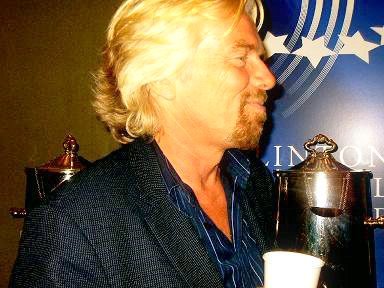
Sir Richard Branson just after the announcement about his company's $3 billion commitment
All photos by Jude Nagurney Camwell


Breaking News: At the Clinton Global Initiative Meeting this morning, Sir Richard Branson, CEO of the Virgin group has just commited profits from the Virgin group to focus on tackling issues related to Global Warming for estimated value of $3 billion over the next ten years. Yes, that was three billion dollars. Developing environmentally friendly airline fuel is one of Sir Branson's hopes. Investing in new fuels and getting away from fossil fuels is the only way he believes we'll beat global warming.

From a press release:
Branson announced an estimated $3 billion commitment toward bio-fuel initiatives. Over the next ten years, Virgin Group will invest all future profits from its airline and train businesses into renewable energy initiatives both within the company, as well as further investments in new
bio-fuel R&D, production, distribution and other projects to tackle emissions related to global warming.

"We know that there's a lot of work to do around the world, and a lot of good to do in fundamentally different ways," said President Clinton. "That's why it's hard to overstate the importance of individuals taking action in whatever way they can. I'd like to thank Richard Branson for joining more than 100 individuals and organizations that have committed to change. Richard's commitment is groundbreaking not only because of the price tag - which is phenomenal - but also because of the statement that he is making: Clean energy is good for the world and it's good for
business."

"We have to limit our dependence on fossil fuels," said Branson. "We hope that this contribution will help in some small way to enable our children to enjoy this beautiful world."
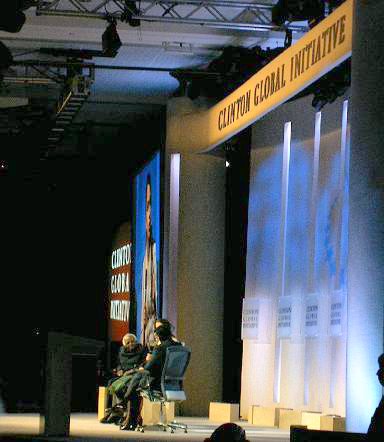
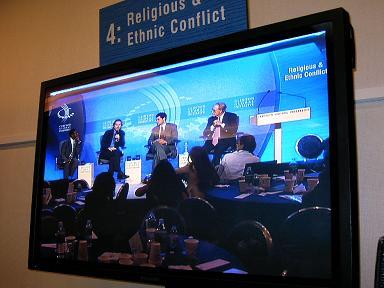
There was a great panel discussion this morning in the Ballroom of the midtown Sheraton that was mediated by Fareed Zakaria. The panel included Queen Rania Al-Abdullah from the Royal Hashemite Kingdom of Jordan, President Hamid Karzai of Afghanistan, and the Archbishop Desmond Tutu. The topic was Managing Divesity in a Globalized World. (more to follow)


Panel session at this morning's CGI meeting in Manhattan


Managing Diversity in a Globalized World


"The only thing that counts is faith working through love."
- Galatians 5:6b


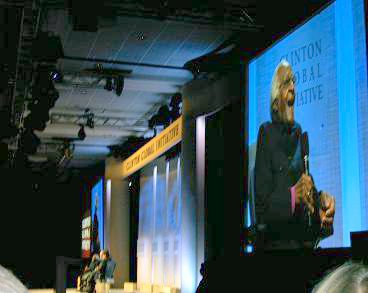
I wish that everyone had been able to see and hear the Archbishop Desmond Tutu speak to the meeting participants this morning. He is a bright light in an often too-dark world. He leads by inspiring others with a hope they might not otherwise be able to see with their own mind's eye. When asked by Mr. Zakaria about the Pope's recet comments which had incendiary consequences among Muslims, the Archbishop commented that he believed that Pope Benedict XVI probably wishes he hadn't said what he did and that he's made the attempt to publicly apologize in good faith, which is sometimes a difficult task for anyone - even himself.

We are a global family and we won't win a war "on terror" as long as we create conditions or allow conditions where people are desperate. We'll survive only together. Free only together. Safe and secure only together. There's no such thing as 'totally self-sufficient.' In fact, to be 'totally self-sufficient' is sub-human.

He stressed that the propagation of murder is never a part of any faith of which he knows. Compassion, justice, love, and charity are the fundamentals of faith that must not be suffocated. We need to hold on to that and underscore the fact that religion, in and of itself, is morally neutral - neither "good" nor "bad. He used the analogy of religion to the knife. You could use a knife to cut bread and you could use that same knife to stab someone in the gut. We in the West tend to put the words "Muslim" and "terrorist" togther easily, but we hesitate to use the IRA or those responsible for the Holocaust as "Christian terrorists." (This got a round of applause from the audience). President Hamid Karzai of Afghanistan went on to mention that he believes that citizens in the West do not have a good understanding of Muslim societies and beliefs and that it would serve the world well for Westerners to be enlightened. He wonders if Western citizens realize that Muslims were killed and mosques were destroyed by the same terrorists long before 9/11 occurred. Thinking back to how we are a gobal family, President Karzai reminded the audience that hate was being preached in some mosques in Afghanistan before 9/11 and the West didn't pay attention, likely because the West wasn't directly affected - and he believes that was wrong. Judging from their hearty applause, the audience agreed.

Mr. Zakaria gave Archbishop Tutu the last word. He asked "Are you optimistic in light of what so many call the clash of civilizations? Re you hopeful?" His answer? "Absolutely." He described the UN Alliance of Civilizations, of which he is a leader, as a "most diverse bunch of creatures."

You can see the session here.


The Archbishop Desmond Tutu joyously speaks of hope to the audience of CGI participants


Global Health


Have you ever heard of river blindness? An annual vaccine is necessary to prevent the blindness, and the expense can be very great. Vaccines can prevent this disease which affects people in developing nations, but business and governments need to partner to come up with solutions to cure the diseases that our children will likely (and thankfully) never be forced to encounter. In this morning's workshop session on Global Health, former President Jimmy Carter joined a panel mediated by George Stephanopoulos and came to the agreement that there has been a serious impact of diseases due to a great level of neglect in the countries where help is needed most. A new hookworm vaccine could be mass produced iexpensively, but it is not a popular shareholder interest. The Bill and Melinda Gates Foundation has endowed $18 million toward manufacting and distributing the hookworm vaccine. We can't rely on them forever (Stephanpoulos joked, "Well, at least for a long time.") It was agreed that more players are needed.

The problem of multiple diseases being tackled one at a time can cause double-efforts, unnecessary costs and delays. Integrated service deliveries have been more successful, and we must invest in an integrated system where poor communities can recieve quality and comprehensive health services.

New technologies for diseases? Pesident Carter pulled no punches about pitching for funding for his own project. The Carter Center is gearing toward an idea in which their plan runs in harmony with the health ministry in Ethiopia coordinating mosquito-repellent bed nets ($5 each) which will prevent multiple diseases. By August 2007 the Carter Center hopes to have every endangered Ethiopian safe from malaria and other diseases. Some very poor nations have no idea that help even exists for their needy citizens.

Questions were asked of the panel and participants and they were given thirty minutes to discuss the issue and come up with some answers - and perhaps more questions. Drugs (rapid impacy package moral obligation to maximize use of the drugs.
One Question:
What incentives would help business to be interested and effective in the prevention and treatment of tropical diseases?
Advanced purchasing commitents to produce more life-saving drugs should be encouraged. Delivery and infrastructire for health care can be improved and a good start would be making the most out of existing infrastructure for the distribution of new drugs. Ideas were discussed among panelists about foundations, with funding from business and other sources in the private sector, pushing for concentrating on the eradication of one disease - concentrating on one may speed the eradication.

Donna Shalala joined President Carter to present commitments. One commitment was from Victoria Hale of One World Health. Ms. Hale made a commitment of $27.4 million over 5 years to be used to eradicate (black fever) visceral leishmaniasis - the second greatest kiler afer malaria in Ethiopia and other poor nations). Pierre LeFarvre of the World Diabetes Foundation will assist young citizens in Capetown Africa. He's made a commitment for a school-based intervention for ages 10-13 to treat Type 2 diabetes. Over the next 3-4 years, he has committed about a million dollars.


Al Gore Speaks on
"Building a Sustainable Future"
Panel


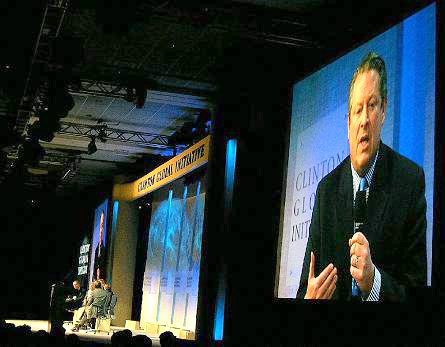
Former VP Al Gore called for a new great generation with a moral cause to solve the global warming/climate change crisis.


From The Politicker blog, New York Observer:
On a stage at the Sheraton in midtown, in front of Mr. Clinton, Tom Golisano, Colin Powell and hundreds of representatives from the business, donor and non-profit community, Mr. Gore delivered an impassioned speech that brought the audience to its feet and had people chattering about what a great President he would have made -- and maybe could still make.

"This crisis is the by far the most dangerous we have ever faced in the entire history of human civilization but it also provides the greatest opportunity," he said with increasing volume. "We are coming together as a Global civilization in our lifetime we have to get our act together and this climate crisis, may, I believe, does, gives us the opportunity to rise, to gain the moral authority and gain the vision not to become the self-destructive, selfish generation, but to become the next greatest generation."

Clinton then made sure that Gore stood next to Branson when the billionaire announced his donation to the whole crowd. Gore, conspicuously elated as he signed his name with Clinton onto the pledge, said that it was "like the old days."

--Jason Horowitz

More to follow.....

Over $7.3 billion dollars committed at Clinton Global Initiative Meeting


Over $7.3 billion dollars committed at Clinton Global Initiative Meeting

President Clinton delivered the closing address of the 2006 Clinton Global Initiative (CGI) this morning and anounced that the 2006 meeting had secured over 7.3 billion dollars. He also thanked the bloggers who spread the news of the meeting results throughout the globe via the internet.

Blogger Ted Widmer said something with which I agree. I wish that I had six or eight blogging hands and could be in multiple places at one time. Ted writes:
Events are now outrunning any single writer's ability to describe them. Part of the genius of CGI is that its loose, democratic organization mirrors its overall philosophy. In other words, there are hundreds of small conversations taking place in hallways and business centers and coffee lounges across the hotel. A lot of this activity is spontaneous, and designed to be. But in other ways, it's organized down to the nanosecond. No detail is too small - cardboard coffee holders that suggest little acts of environmentalism, for example (suitably chastened, I decide to protect the environment a little more by not even using one).
Because one blogger could never cover all of the vibrant conversations taking place here at the Clinton Global Initiative meeting, here are some links to other blogs about the meeting:

The CGI blog

Tom Watson/News.onPhilanthropy and Drum Major Institute

CGI webcasts

Dave Johnson/Seeing The Forest and Social Edge

Barbara O'Brien/Mahablog

Jessica Valenti/Feministing

NYCE/Daily Kos

Google search: Clinton Global Initiative

Google blog search on Clinton Global Initiative

Google Blog Search: CGI


Thursday, September 21, 2006

CGI Workshop on Darfur


CGI Workshop on Darfur

Trading in on your celebrity or cashing in on your business influence is ethically neutral in and of itself. Most people would probably see it as "bad" if someone uses their influence for matters of greed or pure self-interest. What do most of us see as the right thing to do? A person might use their corporate influence in a way that sheer profiteers would consider crazy because there's no pocket value in it. A celebrity might "throw his weight around" in the service of human rights, and he might be inspiring and followed - or he might be called a "Hollywood busybody" by careless naysayers. In a discussion today at the Clinton Global Initiative meeting, it was clear that two particular men have cast aside the possibility of worrying too much about any of those public perceptions while they are in the service of their fellow men and women's human rights. They are hoping that other world citizens will join them.


As a rule, pure altruism isn't what gets people motivated - it's their pockets. One witness to genocide's consequences is actor Don Cheadle, who starred in Hotel Rwanda a number of years ago. He experienced a personal transformation after talking with victims of genocide, and has been an activist since. He would like to think that we're moving beyond the "Oh my God" when we hear about atrocities in Darfur and that we're moving toward acting for the real alleviation of suffering.

There are no customers or business prospects in Darfur today, so many in the business world ask Timberland's Jeffrey Swartz, "What are you doing in Darfur?" He reflected the personal truth that "sometimes you choose - and sometimes you're chosen." You can choose to be an illogically involved CEO or "Missing in Action" while people die. He made his choice firmly: "Mark me as illogical."

This question does not have easy answers: How do we avoid using tired and failed activism strategies? Mr. Swartz has thought a lot about the private sector and how he and other socially conscious businesspeople can put the pressure of the marketplace to work. He suggested that, together, we all can create sensible and successful solutions in Darfur and that it's not a notion borne of business sense, intellect, profit or gain - it's a visceral notion. He stated proudly that those suffering in Darfur could count on him to be "on their side."

John Pendergast works with the International Crisis group. In Sudan, Crisis Group suggests strategies for peace in Africa's largest country, riven by ethnic and religious divisions, and multiple conflicts, including in Darfur. Mr. Pendergast asked the question that so many have recently asked, including celebrities like Mira Sorvino, Archbishop Desmond Tutu, as well as George Clooney and Elie Wiesel who were in front of the the UN Security Council last week. "Why does nothing real seem to occur?" He says that bell-ringing for "anti-hypocrisy" is important to geting to a meaningful and effective solution to the societal atrocities in Darfur, and that it is the worst human rights disaster on the face of the earth today.

Following General Colin Powell's past speech to the UN on Darfur, there was hope that the 'sacred covenant' implicit within the international community and their oft-used slogan "never again" would be enough to spark real action and inertia. Unfortunately, there are politcial priorities that are constant obstacles to a meaningful solution and they can only be overcome by a "raise in temperature" through citizen action. Faith based communities and students are the ones primarily pushing for solutions on Darfur today. They have developed emotionally-inspired commitments to press for action. These "rag tag" groups want "never again" to be a statement that we truly mean and that we just don't say it, throw up our hands, and do nothing.

If the international community recognizes this as "genocide," the choice of "Do Nothing" or a "Non-consentual deployment of force" is a false choice. There are many other ways in the middle to address the human rights disaster. Violent counter-insurgency strategies with no international political costs to the government of Sudan is not going to change the Sudanese government's behavior. We, as a global community, need to impose that cost if we are to act as a moral people who show the people of the world that its leaders mean what they say.

Panel member agreed that what is needed is a continuation of a groundswell-building of information. Darfur is under-reported by media, barely in the news at all. CGI is one real-world soution.

For Mr. Cheadle, speaking at demonstrations and premieres is a way that he personally educates citizens about the Sudan crisis. Leaders, in general, respond to what they believe their constitiuency wants, and is the only thing that captures their attention from the usual special interest "gods" that they serve. To each and every citizen, Mr. Cheadle says that there will be no rally and no action if you do not take any personal steps. To him, it is disturbing to know that we're still sitting down and having to talk about what has been happening for so long. He looked into the eyes of those who had directly suffered. Rwandan citizens - human beings - pleaded with him to tell their story and he promised to do so. He commented that when you do that and you don't see the line moving, it's pretty frustrating. On the hopeful end, Mr. Cheadle feels that disparate groups are beginning to coalesce.

A political solution is the only thing that will wind up stopping the killing. Pressure must be put on the Sudanese government to put a stop to the violent counter insurgency strategies that are senselessly taking so many innocent lives.

Hope has been the tone throughout the CGI meeting. Combine that with common sense solutions from workshop meetings and funding commitments, and we may have hope for many new miracles - great and small.

_____________


A light note: One solution the working group suggested toward the session's end was to clone Don Cheadle!


Elizabeth Edwards' Saving Graces


Elizabeth Edwards' Saving Graces


On the Today show tis morning, there was a short segment reporting that Elizabeth Edwards, wife of Senator John Edwards, is cancer free. A Reuters article reports that there are excerpts from her book "Saving Graces - Finding Solace and Strength from Friends and Strangers" featured in a current People Magazine, where she gives a graphic account of what she experienced in her treatment for the disease.

Mrs. Edwards is expected to be a guest on the Today Show along with an extended feature later on the NBC Nightly News on October 2, 2006.

Mrs Edwards sent this email today about her book:


As you may have heard, I've finished writing a book about you, and it is about to be published. Actually, it is not you in particular (although you may recognize yourself somewhere on its pages). It is about the bigger "you" -- the "you" I talked about in the 2004 campaign, the "you" who sustained us for those two years and who sustained me throughout all the valleys and peaks life has brought.

The book is called "Saving Graces: Finding Solace and Strength from Friends and Strangers." I hope it is a tribute to the power that community can have in our lives. I know that I have been -- and I believe we all are -- always stronger and better when we let the strength of others help us. "Saving Graces" is about those connections and the support they've given me in my life.

I wanted to share "Saving Graces" with you before the book comes out -- next Tuesday -- because I know firsthand that some of the most important connections in our lives may not be face-to-face. I found them in the mail, on the phone, and -- as I describe in the book -- certainly through the internet.

I've been blessed with some amazing gifts in my life, but like most families, our family has faced some difficult challenges. Some have been very public; some have been very private. But whatever the challenge, I have never had to face it alone. Every step of the way, my relationships -- with family and friends, with strangers who have shared similar experiences, and with supporters and believers united in a common cause -- have given me strength and carried me through.

In my book, I write about what it was like to grow up in a military family, moving frequently and learning to make friends wherever we went. I learned, too, that a room of strangers is just a temporary condition, which can be cured by a smile and handshake and making the effort to find what we shared. The lessons of the support and comfort from my extended Navy family have been invaluable every day of my life. I write about the bonds we formed in the 1960s when young people across this country were opposed to the Administration's commitment to a war in Vietnam. I write about meeting John and marrying John, and the simple pleasures of exchanging favors with other parents and neighbors as we raised our family and built careers in Raleigh and Chapel Hill. And, of course, there's plenty to read about the privilege, responsibility, and even fun of a presidential campaign and about the thousands of incredible people we had the opportunity to meet.

I also discuss my fight against breast cancer -- especially the overwhelming support of the tens of thousands of people who made me feel like they were fighting beside me. They -- you -- wrote, emailed, prayed, and, in perhaps the greatest gift, shared personal battles against cancer and illness. I will never be able to thank them -- you -- enough, but this book is a start.

Finally, as hard as it was to write, there is no way I could write about the power of community in my life without writing about the death of our precious son, Wade. As many of you know, Wade died in a car accident in 1996. So many people reached out to us -- with compassion and love, of course, and often with their own stories of loss and grief. I cannot overstate what those connections meant to me. Their support and inspiration -- much of which came online -- will always be with me.

So this book is a thank you to all those who have made me stronger, and it is a message to anyone struggling to cope with the daunting challenges that life sometimes lays before us. Optimism was easy even in the face of obstacles because you believed in tomorrow and told me there would be brighter days ahead -- and you were right. Thank you for taking a moment to read this. And thank you for being a member of our community.

Sincerely,
Elizabeth


Wednesday, September 20, 2006

The Clinton Global Initiative


The Clinton Global Initiative

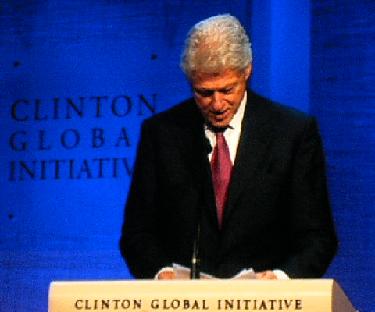
President Bill Clinton at the 2006 CGI Conference

The second annual meeting of the Clinton Global Initiative (CGI) officially launched this morning with an opening plenary session which included First Lady Laura Bush and panelists including President Ellen Johnson-Sirleaf of Liberia, President Pervez Musharraf of Pakistan, President Alvaro Uribe Velez of Columbia and Javier Solana, the Secretary General of the Council of the (EU) European Union.

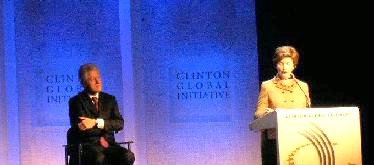
President Clinton introduces First Lady Laura Bush

At the plenary session, President Clinton announced the first five commitments of 2006, including a commitment by Mrs. Bush to provide thousands of citizens in sub-Saharan Africa with safe drinking water. Mrs. Bush committed a $16.4 million pledge from USAID, PEPFAR, the Case Foundation, and the MCJ Foundation. These committed funds will provide Play Pumps water systems to more than 1000 communities and schools in sub-Saharan Africa to provide thousands with safe and clean drinking water. It's both an ingenious and simple idea. It harnesses human nature and child's play to make it work.

The panel at the opening plenary was mediated by NY Times columnist Thomas Friedman, who asked a question of each panel member - "If the 'Clinton genie' could grant you one wish - what would that wish be?" I will provide some of their answers for you at a later time.

President Johnson-Sirleaf stressed the belief that the people of her nation's localities need to set the priorities for their needs in order for those needs to be realistically and successfully met. (re: schools, clinics, business needs, etc). The returning refugee population in her once turbulent nation need tools and seeds for farming in order to revive agriculture in Liberia.

President Musharraf made a plea for a return of diplomacy in world affairs. During the panel session, he stressed that a global divide was growing and that problems in the Middle East contribute to that divide. He sugested that we all need to build bridges rather than to burn them; to move away from extremism with something other than simply a militaristic solution. He stated that it was his opinion that Pope Benedict XVI's recent words - the ones that inflamed so many in the Muslim world - were "unwarranted." He believes that many in the Islamic world are already experiencing poverty and hopelessness; they feel a sense of abandonment and misunderstanding. "Rubbing salt in their wounds" is not a successful solution. He said that the cart cannot be put before the horse - that the Palestinian conflict lies at the core of many of the problems of extremism and terrorism. He doesn't trust that struggles such as the Iraq War will "fall in line" until the Palestinian problem has been resolved. He touched on some other political topics that I will cover in future posts.

Mrs. Bush speaks

Secretary General Javier Solana said that, without security, there can be no successful development. We all have a responsibility to protect the innocent from genocide - and we must remember that there are consequences when we use that very word. When Mr. Friedman asked Mr. Solana about a single policy change the EU could take right now, he said world leaders need to continue working together toward the alleviation of suffering and as a force for international security. Barbara O'Brien (Mahablog) has a lot more on Mr. Solana.

Keeping busy in the press room.


There were afternoon sessions held on four focus issues: Climate Change, Global Health, Poverty Alleviation, and Mitigating Religious and Ethnic Conflict.

I listened in to workshop sessions on Global Health and Mitigating Religious and Ethnic Conflict. I also have some video from a Press Conference held later in the afternoon by the session leaders. I'll share that with you at my earliest opportunity.


Later on...
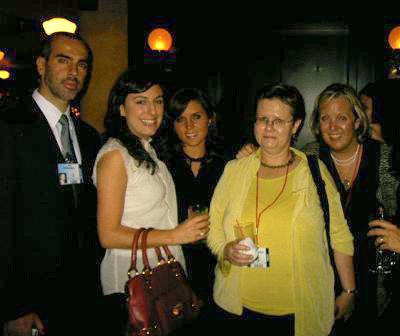
Some of the bloggers who attended the CGI conference at a Press Reception.

I have much more to tell you about this conference, but it's late and I have to be back in the morning. One thing I'll leave you with is that I've talked to a few people this evening and one common thread running through the opinions offered about Day One of this conference is that the issues and the way they're being aproached and embraced by those participating in the CGI commitment process is generating a feeling of hope for this world that few have sensed for a long, long time.

Monday, September 18, 2006

First Lady to Speak at Clinton Global Initiative Conference and UN


First Lady to Speak at Clinton Global Initiative Conference and UN
"This is one of those rare things." *

There are times when the needs of our world take precedence over partisan politics. I believe this is one of them. The Clinton Global Initiative conference looks beyond politics and toward a mission that President Bill Clinton has characterized, inspired, and animated by relating it to the Founding Fathers' ideas about "forming a more perfect union" - on a global scale.

The second annual CGI conference will be hosted by President Clinton with guests such as First Lady Laura Bush, Bill & Melinda Gates, Warren Buffett, President Pervez Musharraf, President Hamid Karzai, King Abdullah & Queen Rania of Jordan, Senator Hillary Rodham Clinton, Shimon Peres, Kofi Annan, Colin Powell. Attendees will participate in workshops and meetings focused on four main topics:

- energy & climate change;
- mitigating religious and ethnic conflict;
- poverty alleviation;
- global health.


Attendees will make specific commitments to address one of the topics covered and will report to President Clinton on the progress made throughout the course of the coming year.


A Special Note:
I'll be attending the Clinton Global Initiative Conference as a blogging member of the press and hope to keep you updated with brief highlights during the week and more in-depth coverage after the conference.


Mrs. Bush to Speak On Myanmar


map credit: National Geographic


Mrs. Bush will also host her own conference this week on global literacy as the United Nations' honorary ambassador for the Decade of Literacy. She'll also be promoting the White House agenda on Myanmar (formerly Burma).

She'll confer with U.S., U.N. and NGO reps on the situation in Myanmar, a nation that has been long criticized for its repressive policies and detention of the pro-democracy leader Aung San Suu Kyi (for whom the U2 song "Walk On" was written and dedicated.) The Myanmar government is indeed a dictatorship, 'roundly criticized for human rights abuses ever since it killed an estimated 3,000 pro-democracy demonstrators in 1988 and subverted the results of a public election in 1990. The year before, the government had put the elected president, Nobel Peace Prize laureate Aung San Suu Kyi, 60, under house arrest, where she remains today.' [source: National Geographic]

To give a unique perspective on Myanmar, a naturalist/wildlife biologist who I admire for his tenacity, hope, and rugged courage, Alan Rabinowitz, has been trying to deal with this repressive government for decades while helping them to establish an 8,452-square-mile tiger reserve in the rain-forested Hukawng Valley. Lately, Mr. Rabinowitz has run into problems that seem to have only been exacerbated by a hard-line government...and for him, time is running out...
From National Geographic:

Hard-liners have come to the fore in the Myanmar government, engaging with Asian neighbors who seem to care more about clear-cutting Myanmar's jungles than preserving them. Across the country, and particularly in remote, rural areas, the government has conscripted locals into forced labor to build railroad lines and military outposts, raising doubts as to their intentions with this large new reserve. And even as he plans his return trip to help salvage his life's work, Rabinowitz feels an added sense of urgency. Four years ago the robust scientist was diagnosed with incurable leukemia, and there's always a chance that his next trip may be his last.


*The quote used above is from edverb in reply to a blogpost about Mrs. Bush's upcoming speech.

Announcing WNCNN Netroots Political Show


Announcing WNCNN Netroots Political Show


Western North Carolina News Network Launches Political Program
September 18, 2006 - Asheville, NC


Western North Carolina News Network (WNCNN), created by local political organizer, Gordon D. Smith, is political satire presented as a cable news program in the vein of Steven Colbert's The Colbert Report and Jon Stewart's The Daily Show. WNCNN will air weekly on Mondays on numerous internet sites including YouTube.com beginning on September 18, 2006. The series intends to highlight the shortcomings of Republican incumbent Congressman Charles H. Taylor through the use of satire, sarcasm, and visual humor.

Smith says of the show, "Too many people are turned off by dryly produced news programs and nasty campaign ads. WNCNN is a way to learn more about Charles Taylor and have a good laugh at the same time." Exclusively aired on internet sites, WNCNN's target audience is made up of the "netroots", a broad-based demographic of politically minded internet users. The weekly series will be available at Youtube.com (http://www.youtube.com/user/wncnn), DailyKos, MyDD, BlueNC, Scrutiny Hooligans, and a host of other political blogs and websites. "Scores of political blogs and websites will link to the series and will advertise it through a graphic logo at their sites," Smith added, "We expect to have 10,000 viewers for our first episode, and we'll see where it goes from there".

WNCNN is not affiliated with any campaign or political organization. It is an example of netroots activism with a sense of humor. The weekly series will, through newsdesk style performance and on-the-scene "reporting", lampoon the record and reputation of Congressman Taylor. "It's all in good fun," Smith says, "and it's a good way for people to learn more about the incumbent." To view the first installment and future installments, go to http://www.youtube.com/user/wncnn. To contact the show's creators, writers, actors, and producers, email them at wncnn@yahoo.com.

Sunday, September 17, 2006

Constitution Day & The Sage of Gunston Hall


Constitution Day & The Sage of Gunston Hall


Constitution Day is today - September 17. Last Tuesday, in honor of this special day, I visited Gunston Hall, the home of George Mason (1725-1792), creator of the Virginia Declaration of Rights adopted in 1776 and used as the model for our national Constitution's Bill of Rights.

A tour guide named Ed gave me an extremely interesting and amusing history of the home, right down to the story of a silver bowl in the dining room in which each of the tweleve Mason children were baptized (of which only nine survived infancy) and the 250-year old hawthorn and cedar hedges that line the path to the beautiful Potomac.

As the delegates gathered at the Pennsylvania State House in May 1787 to "revise" the Articles of Confederation, then-Virginia delegate George Mason wrote,
"The Eyes of the United States are turned upon this Assembly and their Expectations raised to a very anxious Degree."
Mason's previously written Virginia Declaration of Rights had strongly influenced Thomas Jefferson in writing the first part of the Declaration of Independence. He left the convention bitterly disappointed in 1787 and became one of the Constitution's most vocal opponents. "It has no declaration of rights," he was to state. Ultimately, George Mason's views prevailed. When James Madison drafted the amendments to the Constitution that were to become the Bill of Rights, he drew heavily upon the ideas put forth in the Virginia Declaration of Rights. [source: NARA]


photo credit: On Line Tour of Gunston Hall/Hal Conroy


I was most impressed with one small item - a writing desk in a room called "the little parlor." It's in that small room where Mason sat down, deep in thought, and penned the Declaration.

Saturday, September 16, 2006

It's Apple Time in the Catoctin Mountains


Tar Heel Tavern: It's Apple Time in the Catoctin Mountains


As the adopted daughter of the Tar Heel Tavern, I am happy to report that Mel's Kitchen is hosting this week's Tavern and that the orchards north of the Carolinas
are abundant with ripe, sweet apples begging to be used in our favorite recipes.


Traveling through Maryland on my way home from Washington D.C. this week, I found an hour to stop and enjoy the pastoral beauty of the fields and mountains surrounding the lush orchards at the Catoctin Mountain Orchards along Route 15 in Thurmont.


In this place, you can almost hear the sound of the hawk's wings upon the wind.


The colors of the orchard are the kind that take your breath away.


After you shop at the fruit market, you can stroll around the orchard.


If you have children, you can watch them dream while they play as you sit in a lovely gazebo nearby and do some dreaming yourself.


A Recipe for Pecan Apple Pie:


2 cups apples chopped cooking
1/2 cup brown sugar firmly packed 1/2 cup sugar granulated
1/2 cup flour all-purpose
1 each egg yolk beaten
1/2 teaspoon vanilla extract
1/2 teaspoon lemon juice freshly squeezed
1/2 cup pecans chopped
1 each egg white beaten until foamy
1 each pie shell 9 inch, unbaked

Directions:

Put chopped apples in a large bowl.
Add sugar, flour, egg yolk, vanilla, lemon juice and pecans; mix well.
Add egg white. Stir well and pour mixture into unbaked pie shell.
Bake at 350 degrees for 30-45 minutes


________________________

Other places to visit near the orchards in Thurmont


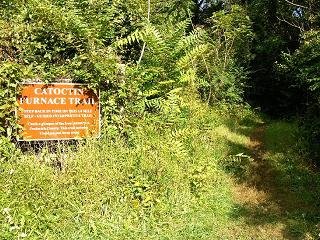
Cunningham Falls State Park - Furnace Trail/Ironmaster's House

A nature trail leads to and from the ruins of an old home and the site of the village complex surrounding the iron furnace. The history of the area can be read about here.


There is a site at the end of a nature trail where the ruins of a once-beautiful home stood. Today, you see the brick walls covered with leaves and vines and the ghosts of the past can still be felt as you stand in silence broken only by the sounds of a bird or the wind through the trees.


_______________________


Also in Cunningham Falls State Park


If you take the nature trail which crosses Route 15 by a bridge, you can listen to water falling gently by in the Manor Area of the park. The park's website is here. Search the park area here.


All photos by Jude Nagurney Camwell

Thursday, September 14, 2006

The Health Care Crisis in Africa

Science and the human heart
There is no limit
There is no failure here sweetheart
Just when you quit


- From the song "Miracle Drug" by U2


The Health Care Crisis in Africa


Are you aware that most Liberians are living off 50 cents a day? Former President Jimmy Carter said at Emory University last night that Liberia and other African countries suffering from major diseases need far more medical attention than they can afford. He told the students that providing shelter, clothing and food on less than two dollars a day -- not to mention health care. He cited the growing economic gap between rich and poor as a major cause of problems throughout the world and encouraged the students to become active as agents of social change.

Next week in New York City, the Clinton Global Initiative will hold its second annual conference with former President Clinton, first lady Laura Bush, Liberia's president, and many other world leaders and experts to set new goals for alleviating global poverty (Senator John Edwards and Dr. Jeffrey Sachs have made this a policy priority), achieving success in assisting all nations with health care issues (for which Senator Hillary Clinton and former President George H.W. Bush have offered much public support), mitigating religious and ethnic conflict (George Clooney and Elie Wiesel's appearance today at the UN Security Council on the issue of Darfur is just one example of involvement on this issue), and creating the way forward on energy and climate change (as former Vice President Al Gore has made a focus).

I am particularly supportive of the alleviation of global poverty and I am especially concerned - deeply so - about ending senseless, preventable HIV infections and AIDS-related deaths around the world. My faith calls me to reach out. My political passion calls me to inform others about what is happening over the horizon - on other shores beyond the limit of their sight...and what they can do to help their fellow human beings. There's no limit to science and the human heart and we will only fail when we stop paying attention - or lose hope - or stop trying.

Liberia's President Ellen Johnson Sirleaf is doing her best to keep her fragile nation stable so that her people can survive, but she has recently disclosed that she fears that some individuals are bent on undermining her government. She made recent American news when she got an uplifting and melodious sendoff after a visit to Georgia Institute of Technology in Atlanta. Since taking office in January, President Johnson Sirleaf has carried a similar message of uplift with her on international visits, trying to drum up investment in a nation that’s in tatters after a 14 year civil war. [source: AP] Some three million people live in Liberia, but after a decade and a half of warfare there are only 34 government doctors catering for their healthcare needs. Fighting has destroyed 95 percent of Liberia's healthcare facilities and the number of trained government doctors in the country dropped from 400 to less then 20 at the civil war's end in 2003, according Liberia's National Human Development Report released recently. [source: IRIN]

President Johnson Sirleaf had been scheduled to speak as a representative of her continent at last month's 16th annual AIDS conference held in Toronto, but she had to cancel her scheduled talk a week before the conference. Scant information on HIV prevalence has been available for Liberia. In 1999, it was believed that 50,000 Liberians were HIV positive. In 1993, the official number was 200,000. Today it's estimated that 3.2% of Liberians are HIV positive. In Nimba county, Liberia, doctors are seeing full blown cases of AIDS but there is nothing they say that they can do for them. They can’t test them to see if they have AIDS since the nearest testing facility is a 14-hour drive away.

Liberia, which lies on the northwest coast of Africa, has more than its share of health care crises and limited resources to control them. The country is unlikely to meet most of its Millennium Development Goals regarding health. South Africa, however has the largest number of H.I.V.-positive citizens in Africa. Recent reports indicate that the death rate among women aged 30 to 34 has become 4.6 times as high as it was seven years earlier and that the death rate among men aged 40 to 44 more than doubled.


Video by Ben Werschkul, photos by Joao Silva for NYT

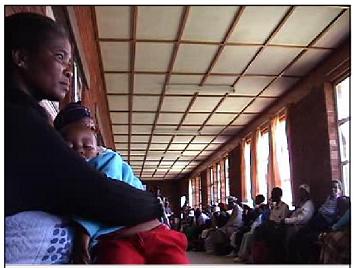
In a Lesotho village, a mother waits with many others in a clinic waiting room so her child may be seen by the one specialist who has come from far away to work in her village. Go to this NYT address and watch a video titled: Video Feature: AIDS Care in Africa.


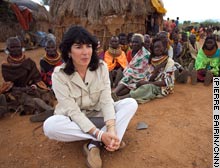
CNN's Christiane Amanpour has been reporting on the effect of the AIDS crisis upon children in Africa. She says that, when it comes to the children, the world has failed dismally. According to the United Nations, there are 12 million AIDS orphans in sub-Saharan Africa alone, and in four short years that number will skyrocket to 18.4 million. That means AIDS orphans will make up 15 to 20 percent of the population in some African countries. Children, many who have been infected with the HIV virus from birth, have to watch their parents dying of AIDS.


There are as many as one million AIDS orphans in Kenya alone, and grandmothers are often the only ones left to care for the children. Grandmothers, many living in poverty themselves, struggle to find enough food for these orphaned grandchildren. Ms. Amanpour gives an example of the Stara Rescue School in the Kibera slum of Nairobi, Kenya, where of the 470 children in the school, approximately 70 percent are AIDS orphans. [source: CNN]


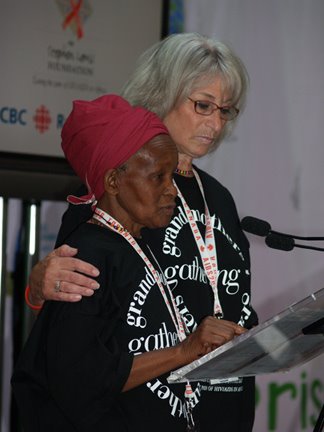
The Stephen Lewis Foundation of Toronto, Canada recently conducted a highly successful grass-roots gathering of about 300 African and Canadian grandmothers. African grandmothers who have lost children to AIDS and are now caring for their grandchildren described their lives to Canadian grandmothers (very few of whom are dealing with AIDS in their immediate families). *Stephen Lewis is the United Nations' special envoy for AIDS in Africa. [source: NYT]


A simple fact that can make a world of difference in stopping the spread of the HIV virus: In the 10 years since the introduction of some highly effective drug cocktails, 20 million people have become infected, and most do not know it because they are not offered H.I.V. tests.


Wednesday, September 13, 2006

President Carter Meeting With Iran's Khatami in Doubt


President Carter Meeting With Iran's Khatami in Doubt

President Jimmy Carter has never been ashamed to say that he places a major emphasis on human rights. It is no secret that the Bush presidents - George H.W. and his son alike - have often been at odds with President Carter for Carter's sometimes assertive post-presidency involvement with international leaders while bypassing the authority of the Oval Office. President Carter firmly believed, before the U.S. became involved in war, that the first Gulf War would be the wrong move for America. It would be the first time we'd have shed blood in a Muslim nation and, always a prescient leader, Carter knew there would be repercussions for years to come.

9/11 was a by-product of America's many foreign policy disasters. Looking back, the first Gulf War was no victory. It was a half measure at best. If America was going to make the world safer back in 1990 by resorting to a war in a Muslim nation, we should have removed Saddam Hussein from power back then, Bush 41 popularity ratings be damned. But politics was played then as politics is being played by Bush 43 now. 130,000 troops in a place like Iraq where 700,000 is closer to the number necessary to occupy the cities, towns, and villages and subdue every insurgent element is an indication that this effort has been far less than a half measure.

Iraq had no 9-11 connection - zip - zero - nada.

Bush now proudly (?) calls Iraq his centerpiece of his war on terror, and he may as well be fighting it with American troops' hands tied behind their backs because it is far less than a hlaf measure.

Bush the chickenhawk tells us that it's a fight for civilization, yet he refuses to look into the eyes of the leaders of Syria and Iran. Some fighter he is. Some civilized example.

President Carter had wanted to meet with former Iranian President Mohammad Khatami when he visited America. Unfortunately, Khatami has said that he appreciated an invitation by Jimmy Carter to meet in Atlanta, but said "his schedule was already full." He said he hoped they might work together later on international peace and reconciliation issues 'if the grounds are prepared'. At least President Carter offered - and it's an open-ended offer. Experts on Iran had hoped that the visit could've opened a channel between America and Iran. Khatami attended the United Nations Dialogue of Civilisations conference in New York, addressed an inter-faith meeting at the National Cathedral in Washington and gave a speech to an Islamic group in Chicago. One Iranian expert in the UK, Dr Ali Ansari says, "This is an important visit because Khatami does still have clout in Iran. Much will depend on how the visit is hand. It is a very delicate matter." If there's one thing we know, it's that George W. Bush doesn't "do" delicate. It would've been quite a twist of fate if President Carter could have made a diplomatic difference with a willingness to look a foe in the eye and talk to him for the sake of humanity.

But don't expect the Bushes to ever support the former President. They are from two totally different Americas. The Bushes are far too proud. Political vengeance is the hallmark of their character. Cheney, too - he's still pissed off at President Carter for a certain letter of November 19, 1990 to international leaders that overstepped protocol. Perhaps President Carter was wrong at that time, but Cheney should have learned a great lesson from everything that's happened since. Unfortunatelyfor America, co-President Cheney is stuck in the muck of his uncivilized, inhumane, undiplomatic, and mistaken past.

Time interviewed Khatami.

A commentator at The Washington Note says:
Carter represents what we COULD have been, and what we should now strive to be. The problem is that a man of a truly altruistic and humanitarian nature, such as Carter, is morally incapable of committing to the kinds of political posturing and actions that allow you to prevail in today's political environment. The only way that society will chose morality over personal material enrichment is if society itself is moral. The despicable reality of the current American political scene is a window into the despicable reality of current American societal values. That is one of the reasons I am so pessimistic about our chances. They only sell us what we willingly buy.

Posted by: Pissed Off American at September 6, 2006 10:50 AM


India Must Be Accountable if a Nuclear Player


India Must Be Accountable if a Nuclear Player

In his latest book, President Jimmy Carter has pointed out that, until recently, all American presidents since Dwight Eisenhower have striven to restrict and reduce nuclear arsenals. Today, U.S. policy is threatening the effectiveness of international agreements that have been laboriously negotiated by almost all previous presidents. Because of the decisions of the U.S. President and some other national leaders, serious doubts have been cast on the future of the Nuclear Non-Proliferation Treaty [NPT], which has been in force since 1970. In rejecting or evading almost all nuclear arms control agreements negotiated during the past fifty years, the United States has now become the prime culprit in global nuclear proliferation. President Bush's move to lift nuclear restrictions and grant privileges to India, who has rejected the NPT, such as having exclusive access to nuclear technology, is a clear incitement for other nations to violate the treaty's restraints. While claiming to be protecting the world from proliferation threats, American leaders have abandoned existing treaty restrictions; have asserted plans to test and develop new weapons; and have reneged on past pledges, reversing long standing policy by threatening first-use of nuclear weapons against non-nuclear states. The world is crying out for positive leadership from Washington.


In this NYT article, US ambassador to India David Mulford is pushing the idea of Congressional approval of what President Carter feels is the wrong path for America on the issue of non-proliferation.
"We hope the Senate will vote this month. If there is Senate action, we believe there will again be a large majority,'' [Mulford] told a Indo-U.S. business summit in New Delhi.
Mulford knows that if it goes past November, there will be more Democrats in the Senate who will take issue with the U.S. lifting nuclear restrictions and granting special nuclear privileges to a non-NPT nation.

India shows that it is unwilling to bend on very important U.S. concerns about accountability with the proposed new nuclear privileges, and that, combined with the fact that they've refused to be a NPT member, should be very disconcerting
Some changes proposed by U.S. politicians include a clause that would make it mandatory for the U.S. administration to certify India is sticking to the deal's terms and a condition that nuclear cooperation would end if it tests an atomic device. [..] New Delhi has repeatedly warned that any changes could destroy the pact.


Tuesday, September 12, 2006

Sen John Edwards & Pres Carter on Universal Health Care


Senator John Edwards & President Carter on Universal Health Care

Senator John Edwards and former President Jimmy Carter seem to get together a lot these days. In July, it was to podcast for the One America Committee Book Club. Yesterday it was to talk about the future of universal health care in America at a convention of the Laborers' International Union of North America in Nevada. Senator Edwards has been a strong supporter of labor unions and the American worker.

President Carter was appearing for his son, Democratic Senate candidate Jack Carter, who has been hospitalized with severe colitis. Here's prayers and good wishes for a quick recovery.

In this week's New Yorker, Blake Eskin recalls David Remnick writing that former President Bill Clinton, while still in office, looked at the examples of the living ex-Presidents — Nixon, Ford, Carter, George H. W. Bush—and saw Jimmy Carter as the best model for his own future. Mr. Remnick explains why it's President Carter.

President Carter will sit down with Larry King on Wednesday night, September 13 (CNN) to talk about the issues of the day.

Former Pres Clinton Meets Progressive Bloggers


Former Pres Clinton Meets Progressive Bloggers

McJoan has a diary up on the front page of Daily Kos in which she's reporting on a meeting that former President Bill Clinton held with chosen progressive bloggers (a la former Senator John Edwards, who has been doing this on a regular basis for over a year now). Barbara O'Brien of Mahabog was among the group of invited bloggers, as was Matt Stoller of MyDD and Pete Daou.

Here's an excerpt from McJoan:
What we did talk about was the rise of the left-wing blogs as a reality-based medium. He's very impressed by the amount of research and fact-checking that happens on the blogs on a daily basis, particulary compared to the traditional media. (Kind of makes you want to double-check everything you write, knowing that Bill Clinton is reading, huh?) He was impressed and grateful for the work done in pushing into the mainstream the travesty that the ABC/Disney movie was. He encouraged Democrats running for election this year to run as Democrats--to not run away from the party, and to stand tough on Iraq--regardless of their position on troop reductions, pull-out, whatever. The issue is making this administration and the GOP Congress that enables it accountable for the massive national security challenges we still face that haven't been addressed in the five years since September 11.


New Yorker Article Profiles President Clinton

President Clinton is featured in this week's edition of the New Yorker, where David Remnick profiles President Clinton. He discusses the former President’s legacy and Senator Hillary Clinton’s political future.


Presidents Clinton and G.H.W. Bush to Receive Liberty Medal at the National Constitution Center

On Thursday, October 5, 2006, President Clinton, along with former President George H.W. Bush will accept the Liberty Medal and its accompanying $100,000 prize, the first under the management of the National Constitution Center. In June 2006, the National Constitution Center reached an agreement with the Philadelphia Foundation to assume all responsibility for the Liberty Medal. Their transcending of partisan and political differences to do what's best for the country and the world through their Bush-Clinton Katrina Fund and Bush-Clinton Tsunami partnership will be honored. It will be the first time both Presidents will be present to accept a joint award for their efforts.

More about the medal.

Bush's Sandwich Speech


Bush's Sandwich Speech

Bush stuffed a lot of lofty rhetoric in his sandwich speech last night (it was raw meat between two wonder-bread ABC drama segments)....but when he spread Iraq on that sandwich, it was like putting mustard on peanut butter.

Iraq had no connection to 911 and Bush politicized the 5th anniversary of his failure to adequately warn Americans about the aviation risks and stop the 911 attacks.

Former NBC anchor Tom Brokaw had this to say to NBC/MSNBC's Chris Matthews last night:

Chris Matthews: “What did you hear in that speech tonight?”

Tom Brokaw: “I was surprised that there was not more poetry in it, a, and b, that he didn't take us to a different place in terms of where he wants to go next. This is the kind of speech that he could have given three years ago, not five years after 9/11. The American public now has been through a lot in five years, Chris, and with all due respect to the President, they'll be measuring his rhetoric versus the reality that they see almost every day in their newspapers and on television. When he talks about all the people who have voted in Iraq, for example, he's absolutely correct on that, but that's touched off this terribly violent struggle over there for power between the Shiite and the Sunni. In Afghanistan, where they've had elections, as well, and I've spent a lot of time in that country, if you get just outside of Kabul, you'll find that women are living a very traditional Islamic life. They're not able to go to a clinic where there are male doctors, for example. That has not changed. It doesn't mean that this is not a noble effort. But, in fact, the policies versus the reality, I think is what a lot of people are going to be looking at. And whether or not we have to find other ways, than just militarily going in to deal with these issues, is the question on the minds of a lot of people.”

Matthews: “You've spent a lot of your life and career involved in the dialogue between the media and political power. It seems to me if you watched the last couple of weeks there's been a dialogue back and forth, almost a deposition, between the media -- especially the White House press corps -- and this President. Getting him to the point where he admitted there was no connection between what happened here and the war in Iraq, the Vice President, because of Tim Russert this weekend, agreeing to that, even though he had been the hardest man to convince on that point. And now here is the President, in a formal speech saying even though there's no confection directly between 9/11. It seems that is how democracy works, a dialectic, an argument back and forth, where one side finally says I don't have the evidence to keep making my case, therefore I'm going to ask you to accept my leadership, that it is a threat to our country even if they weren't involved with 9/11.”

Brokaw: “People have been saying all day long, is this a political speech, are these political appearances? But of course they are. We live in a political system. This is how we work all that out. When he said tonight, for example, that Saddam Hussein was a clear threat to this country, if you watched Tim Russert yesterday, he had the Vice President on saying that, in fact, there was no connection between Saddam Hussein and Iraq. And we had Saddam in a box, which a lot of people believed at that time. The question is, do we advance the goals of trying to suffocate this Islamic rage, which is real, we are still under threat from a lot of jihadists around the world, by fighting the war the way we are in Iraq and doing what we have been doing in Afghanistan, or is there another way worth examining? It's not just a choice between cutting and running, as the administration likes to put it, and what a lot of Democrats would like to do, which is to just get out of there. There are other positions there, as well. This is a very complex war in which we're involved and it requires, it seems to me, more complex analysis than we're able to get in the current political debate.”