Friday, July 28, 2006

Will Turkey Be the Next Problem for America's Interests in Iraq?


Will Turkey Be the Next Problem for America's Interests in Iraq?

Less becomes morally clear as Bush and Blair stall on declaring an immediate cease fire in Lebanon. In a press conference today, it seemed to me that perhaps Tony Blair was forseeing the destruction of the entire Middle East if Bush were left to be Israel's sole (blind) supporter and therefore elected to stand by his side in order to bring a modicum of sanity to the discussion. The problem was, he failed to convince me. A trip to the United Nations to press for action on Resolution 1559 will mean weeks or perhaps even months of more death and destruction in Lebanon at the hands of an unbridled Israel. The offer to build new homes for those who have been spared death by the bombings in Lebanon rings hollow when bombs are still falling. One look at Iraq will tell you how well Bush's vision has progressed there. It's not working out. I'm convinced that neither leader, Blair or Bush, is on the right course, and to hear Blair's mea culpa about his own errors in pre 9-11 leadership must have made former President Bill Clinton shiver with pain and disappointment.

Bush keeps saying he wants to get to the root causes of the problem in the Middle East, but he falls short of realistically or honestly discussing them. As long as he remains on a fundamentalist foreign policy course where you don't talk to the people you see as your enemies - because they are inferior, "evil" or "hateful", you will always have a one-sided solution that will serve no justice for the cause of human rights. Hearts and minds are what have always needed to be won, and Bush is breaking hearts and blowing minds every day with a policy that leaves no room for political solutions - only endless war.

I'm afraid we're only seeing the tip of the iceberg, but the war we began and handled woefully wrong in Iraq, now combined with increased anger at the U.S. for its blind support of Israel and with increased instability between Israel and Lebanon, is sure to spread both outward and inward and break that country into pieces.

Turkish Foreign Minister Abdullah Gul last week summoned the US and Iraqi ambassadors to warn them that Ankara would act in self-defence if effective measures were not taken to end the presence in northern Iraq of the PKK (Kurdistan Workers Party). Turkey opposes the Kurdish demand for quasi-independence and their claim to the city of Kirkuk (in Iraq) and its oilfields. Turkey believes that Iraq's territorial integrity needs to be protected; that Iraq's natural riches belong to all the people of Iraq; that supremacy of ethnic and religious groups over each other should be prevented; and that the disputed city of Kirkuk should be given a special status.

What's happening in Lebanon is having an effect an the Turkish street, and U.S. economic interests could be negatively affected by Turkish instability and war in northern Iraq.

The support given by the US administration for Israel’s massive assault on Lebanon – and the understanding shown by the rest of the G8 – have compounded Turkish premier Recep Tayyip Erdogan’s difficulty in containing domestic pressure to disregard US and EU warnings against a cross-border operation to root out PKK bases in northern Iraq.

Even before the weekend attacks, Erdogan had difficulty in making himself heard in his home town of Rize (on the Black Sea) where a large crowd shouted abuse at the United States and Israel.

Accused of indecision by the opposition and pressed by his own supporters, Erdogan has to respond to the demand for national self-assertion, in spite of the misgivings expressed privately by some of his ministers.

Turkish patrols cross the Iraqi border frequently in pursuit of the PKK and they also have observation posts in Iraqi Kurdistan. If this Middle Eastern war continues to burn with no hope for moral, realistic, or hopeful leadership from the West, how long do you suppose it will be before an all-out war breaks out with Turkey as an aggressor in northern Iraq?

Fu'ad Husayn, an adviser to the Kurdish autonomous region's President Mas'ud Barzani, doesn't appear to have been kept "in the loop." If he knew about any recent trilateral meetings held between the United States, Iraq, and Turkey (about Kurdish interests without the Kurds' participation), he isn't admitting it (the bold lettering below is my emphasis):

Husayn: Baghdad is the capital of Iraq and we [Kurds] are also in Baghdad. Baghdad is not far away from us. I think it would be good if any kind of conflict or misunderstanding would be solved through negotiations around a table. We will support negotiations, we will support any talks.

But of course, we must be informed about the talks and the agenda must not be against the Kurds. We are part of this country; we are part of the Iraqi system. If there is any negotiation in Baghdad about the intervention...the Kurds must be there, and the Kurds must be informed about it.

RFE/RL: But as of now, Kurdish officials are not taking part in these talks?

Husayn: I can't comment on that because I don't have that information. But I didn't hear that a meeting is going on in Baghdad.

RFE/RL: This was reported widely in the Turkish press. There are also unconfirmed reports in the Turkish press this week that the United States has agreed to take action by bombing the Qandil Mountain range.

Husayn: I don't think this information is correct.

RFE/RL: So, you're not worried that the United States would take unilateral steps against the PKK without consulting the Kurds.

Husayn: No, I think one must be realistic if one knows the area...and the relationship between the U.S. and the Kurdish authorities here. I think the information which has been published in the Turkish press is not right.


Turkey Wanted for Lead An International Peacekeeping Force in Lebanon

If there is to be an international peace force in Lebanon, the Lebanese people say they want Turkey to lead it, and Turkey has listed its own conditions for being a part of that force.

Turkey may win some political points from Washington D.C., since they will be dependent upon Turkey's assistance with the crisis in Southern Lebanon.
Ali H. Aslan:

I don’t think that the Bush-Erdogan telephone traffic was focused primarily on the PKK. The Israel-Lebanon crisis must have been the top priority. However, Turkey’s opening its arms to American citizens evacuated from Lebanon when Cyprus’s maximum capacity was filled must have reminded once again those at the top of the Bush administration of the value of Turkey’s friendship in this troubled geographical region. Even if the importance of our relationship has been written down in the “shared (strategic) vision” document, practical benefits become obvious in such dark days
Will a Kirkuk that belongs to all of Iraq come as part of their reward?


~~~~~~~~~~~~~~~~~~~~~~~~~~

Mark Mejia Article on Sibel Edmonds Raises Controversial Questions

In a story only loosely related,Mark Adams asks you to carefully consider this article by Mark Mejia.

Mr. Adams asks: Why is Osama bin Laden still breathing? And he replies to his own question, Ladies and Gentlemen, we may have found a clue.
Turkey's secular establishment, including the Turkish military and intelligence services (MIT), as well as political parties associated with former Prime Minister Tansu Ciller, appear to have been more connected to the Turkish mafia than the Turkish Islamic Parties that Washington abhors. Furthermore, it appears from reading into some of Edmonds' statements that the Turkish mafia was partnered with Osama Bin Laden's al Qaeda network in the drug trade - meaning Turkey's secular establishment was more connected to al Qaeda - pre/9-11 - than were the Islamists in Turkey.(My emphasis - Mark)
This is quite a thought-provoking read - I recommend it, but I do hope you'll use your critical thinking skills to take what is currently conjecture - unproven to date - and not use the information to jump to any immediate conclusions. I find it compelling, in light of these thoughts from Mr. Mejia and Mr. Adams, to know that there us such an increase in passion among the right wing to victimize whistleblowers (when you would think, by nature, for truth, and the "American way", that they would support quite the opposite. Are they afraid of what we might find out?

Wednesday, July 26, 2006

In The News


In The News

IRAQ

William Rivers Pitt on a larger number of U.S. troops returning to Baghdad:


"Sectarian Break-Up of Iraq Is Now Inevitable, Admit Officials," read the headline from Monday's UK Independent. "'Iraq as a political project is finished,' a senior government official was quoted as saying," continued the report, "adding: 'The parties have moved to plan B.' He said that the Shia, Sunni and Kurdish parties were now looking at ways to divide Iraq between them and to decide the future of Baghdad, where there is a mixed population. 'There is serious talk of Baghdad being divided into (Shia) east and (Sunni) west,' he said."

At a minimum, the predicted Balkanization of Iraq points to nothing more or less than the comprehensive failure of the Bush administration to bring democracy to that nation. The Iraqi parliament is today comprised of Shiite, Sunni and Kurdish elements, the three main groups that comprise the Iraqi population. Yet the fighting within this parliament mirrors the bloodshed taking place on the streets, and this signaled desire to split Iraq into three parts means there isn't any hope left for anything other than an utterly shattered state.


At the New York Observer, Joe Conason can hardly believe that a serious journalist would buy the myth perpetuated by nervous consultants that the Internet and it's bloggers "conjured up voter opposition to Senator Joe Lieberman" of Connecticut. He says:


[...] anyone who knows how to read a poll—indeed, anyone who has read a poll during the past several months—knows that popular opinion on the war is strongly negative. The American public now understands that the Bush administration deceived them about its reasons for invading Iraq, that the President never had any serious plan for establishing order there, and that he badly understated the costs and grossly overstated the benefits of “regime change.” They are beginning to understand that his belligerent foreign policy has been a sham, and that his management of the war on terror has been a shame.


DEMOCRATS 2008

Boston Globe columnist Joan Vennochi says Hillary can run - but she can't hide hide behind Bill on Iraq.


Enough with the triangulating. What worked in the last century doesn't necessarily work in this one.

In the past, Clinton ''triangulation'' meant positioning oneself between the Democrats and Republicans in Congress. Now, triangulation means positioning between the two wings of the Democratic Party - the antiwar left and the centrists who don't want Democrats to look ''too angry'' about dead soldiers in Iraq or a foreign policy in meltdown.

In a practical sense, triangulation for Hillary Clinton now means: hug the center. Then, if the center gets bumpy, speed-dial husband Bill to smooth things over [...]

[..] Democrats who support the Bush policy have to stand up and answer for it, just like Joe Lieberman is doing in Connecticut.


In lighter news, here's a must-read from the NY Daily News about Senator John Edwards' yoga experience with hip-hop mogul Russell Simmons.


"He had never seen or done it before. He was a yoga virgin," yoga fanatic Simmons told me yesterday. "The entire practice, he was sweating. The guy runs 5 miles a day, but I promise you he is in pain today. At one point, I looked over at him, and he looked like he was going to die." [...]

[...] Afterward, Edwards accompanied Simmons and his posse — including former NAACP head Ben Chavez and activist Glen Friedman — to dinner at Downtown Cipriani, where they discussed spirituality, how to end poverty, the higher self and other inspirational topics.

"It showed that Edwards is flexible and has an open mind," Simmons pronounced. He added that the evening has sent the would-be White House occupant to the top of his list — and far above Sens. John Kerry and Hillary Clinton. "But I'm happy to go to yoga with anybody who wants to."


Stop Coastal Drilling and Other Giveaways to Big Oil


Stop Coastal Drilling
and Other Giveaways to Big Oil


Many thanks to House Science Committee Chairman Sherwood Boehlert from my neighboring district NY-23. Congressman Boehlert sent the following letter to his colleagues today, explaining his opposition to H.R. 4761, the Deep Ocean Energy Resources Act, which will be before the House tomorrow:


Dear Colleague:

On Thursday, the House is scheduled to vote on H.R. 4761, the Deep Ocean Energy Resources Act. I urge you to oppose this bill. Even if you support off-shore drilling, you might want to think twice about this measure. Here are some of the aspects of the bill you may not be aware of:

· The bill makes it far easier for states to allow drilling than to prevent it. A one-time state petition can open a state’s waters to oil drilling for good, but a petition to bar oil drilling requires several different petitions for each area and they have to be renewed every five years. If a state misses a deadline, the area is open for drilling permanently.

· The bill limits states’ abililty to review specific oil drilling activities once drilling is allowed and limits states’ ability to block pipeline construction.

· The bill makes every other use of coastal waters subordinate to oil drilling. Federal agencies could not take any actions under any law that could conceivably interfere even with future oil drilling.

· The bill allows the Secretary of the Interior to threaten states with a loss of funding if Congress passes any law that restricts oil drilling in any way.

· The bill eliminates many environmental reviews and public participation requirements for oil leases to be issued and for exploration and drilling activities.

· The bill significantly weakens the requirements to mitigate any activities that would harm the environment.

· The bill creates three new mandatory spending programs and would worsen the federal deficit by giving states more than half of all drilling revenues. States now get 27 percent of revenues from drilling that is close to state waters.

Few Members or staff have had time to read this complex, 147-page bill because it is being rushed to the floor for no reason. As of 11:30 this morning, the bill was still being rewritten through a manager’s amendment. This is no way to legislate.

We should not be increasing the deficit and making unprecedented changes in environmental law without even a chance to read what we are voting on. I urge you to oppose this bill.

Sincerely,

Sherwood Boehlert
Member of Congress


The right wing of the GOP wants to do everything it can while it still has control...but not all Republicans are with them as evidenced by Rep. Boehlert's letter.

Let's not let the right wing of the Republican party mar our coastal areas needlessly.


TAKE ACTION NOW

Stop Coastal Drilling and Other Give Aways to Big Oil!


The high price of gas and election year politics has put Florida's coastal areas at great risk of environmental degradation. For the first time in over a decade, the bipartisan consensus to spare coastal areas from drilling has broken down. The House passed a bill ending the moratorium last month, and the Senate is set to vot this week. The Weekly Action Coalition urges you to contact your Senator to oppose opening our precious coastal areas to oil drilling.


From the SF Chronicle:

(07-24) 04:00 PDT Washington -- The Senate is expected to decide this week whether to open vast areas off the coast of Florida to oil and gas drilling, a debate with billions of dollars in energy royalties at stake that could affect the ability of coastal states like California to prevent drilling off their shores.

Senate Republicans want to allow drilling in Lease Area 181, a portion of the eastern Gulf of Mexico south of Florida's Panhandle that is believed to contain one of the nation's largest untapped reserves of oil and natural gas. Proponents claim that opening the new area could help rein in the high energy prices consumers are paying and reduce America's dependence on foreign sources...

(E)nvironmentalists and many California officials are worried (that) the bill, if approved, could be merged with a more sweeping House measure approved last month that would end the quarter-century federal ban on drilling off the Pacific and Atlantic coasts and offer states lucrative financial incentives to approve oil and gas exploration.

"It is too early to speculate about what the final Senate bill will look like and what compromise, if any, can be reached in conference," said Rep. Lois Capps, D-Santa Barbara, a leading opponent of drilling in the House. "I would submit that any expansion of offshore drilling is a step in the wrong direction because it continues to enable our addiction to fossil fuels rather than pursuing efforts to reduce consumption and develop alternative energy sources."

California's two Democratic senators -- Dianne Feinstein and Barbara Boxer -- had joined with New Jersey's two Democratic senators to stop the bill, until they received assurances it would not harm their states' coasts. But Senate Republican leaders decided to put the measure on the fast track, despite the threat of a filibuster led by drilling opponents. Key votes on the drilling measure are expected as soon as Wednesday.


From Save Our Environment.org:

Dear Senator:

As your constituent, I urge you to protect America's Gulf coast and oppose S. 2253, sponsored by Senators Pete Domenici and Jeff Bingaman. The Domenici-Bingaman bill would allow oil and gas leasing and drilling in millions of acres off of Florida's Gulf coast in an area known as Lease Sale 181.

Florida's coast is a complex mosaic of sea grasses, wetlands, bays, estuary systems, beaches and dunes, and offshore drilling is simply not compatible with the quality of life and economy this fragile ecosystem supports. That is why both Florida senators, Senators Martinez and Nelson, are opposed to S. 2253.

Finally, there is not much oil and natural gas thought to be in the eastern Gulf of Mexico. At current rates of consumption, Florida's coast probably contains less than four months of oil and only six month's worth of natural gas.

Obviously, we cannot drill our way out of our energy problems. There is simply not enough oil and natural gas off of Florida's Gulf coast, certainly not enough to reduce prices or make America energy independent.

We strongly urge you to vigorously oppose - and not sign on as a cosponsor - S. 2253, the Domenici-Bingaman bill, and oppose any attempt to lift the moratorium for offshore drilling off of our coasts. Instead of promoting drilling projects that harm our coasts and do nothing to solve our energy problems, we urge you to support energy projects that promote energy efficiency and renewable energy.

Thank you for your consideration.


Send this letter to your Senator.


Where Do We Find Cross-Faith Commonality?


Where Do We Find Cross-Faith Commonality?


Being human - simply human - helps us to understand that we of different faiths have common threads that can be woven together to achieve the most loving accomplishments - not in Heaven - but with God's help here on earth.

_____________


Religion writer Cathleen Falsani [Chicago Sun-Times ] has written her first book, "The God Factor: Inside the Spiritual Lives of Public People."


Although many of her interview subjects had traditional conceptions of God and spirituality, others did not. However, Ms. Falsani says there was a similarity that characterized just about every single person she interviewed. "As I look back on it, I can see two themes that emerged," she says. "First, everyone in the book was mindful of the fact that they were blessed. And secondly, they were aware of that, and therefore felt an obligation to give something back."


"Embodied faith recognizes it's not enough to save souls or enlighten minds if people are still languishing in sickness, poverty, or injustice, and embodied faith recognizes that physical violence in the name of spiritual truth is the most heinous sort of abomination."

- Lorianne Sabato


Lorianne Sabato of Hoarded Ordinaries speaks of a common call to humans as spiritual beings that she refers to as an "embodied faith," of which fundamentalism can play no productive role.

Jesus Christ was "grounded." Because he was flesh and blood - as are we - I believe that any Christian can identify Jesus (and themselves) with Lorianne's "belly-instinct" description of spirituality and faith. Jesus was brought up in the Jewish faith. He had mastered the wisdom of his faith by the age of twelve, if we are to believe the scriptures. In Luke 2:46-52, you see the "belly instict" in Jesus' mother Mary, as she comes to accept and embrace that which she does not understand through love for her son and faith in God:

46 And it came to pass, that after three days they found him in the temple, sitting in the midst of the doctors, both hearing them, and dasking them questions.
47 And all that heard him were astonished at his aunderstanding and answers.
48 And when they saw him, they were amazed: and his mother said unto him, Son, why hast thou thus dealt with us? behold, thy father and I have sought thee sorrowing.


49 And he said unto them, How is it that ye sought me? awist ye not that I must be about my Father’s business?
50 And they understood not the saying which he spake unto them.
51 And he went down with them, and came to Nazareth, and was asubject unto them: but his mother kept all these sayings in her heart.


Although, as the Mishnah (oral law) in modern-day Jewish tradition requires boys of that age to become conscious of the faith, the average twelve-year old would not have had Jesus' capacity for such depth of spiritual knowledge without having had first passed through the training of Rabbinic schools. The fact that young Jesus had worried his mother sick when he disappeared in Jerusalem shows that, in some ways, he was very much like a typical twelve-year old. Yet, he amazed the scholars with his strong wisdom borne of pure faith. His sense of mission and self-awareness was intense.

The Jews asked about Jesus, after he'd grown to manhood, "How doth this man know letters, having never learned?" How do any of us know of Heaven what cannot be known on earth? Does the voice come from our bodies? From our minds? From the earth? From the Heavens? No one knows, but one thing I've come to understand is that each common thread that has been woven through every act of human progress creating a quilt of peace and understanding here on earth has shone, like the sun, with the light of love. The fact that I use the words "sun".."thread".."quilt"..tells you that I need to refer to that which exists here on earth in order to communicate my idea of Heaven to you. Jesus Christ's time here on earth would have been lived in vain if we Christians missed the all-important point that he tasted the fig, heard the call of the birds, felt the morning breeze brush his cheek, experienced a mother's devotion, and had lain on his back looking at the sky - dreaming. That, to me, is part of the embodied faith that Lorianne is speaking about:


I've already pointed you toward Rev. Bruce Prescott's excellent definition of "progressive faith", and over the past day or so I've been thinking that I might add an eleventh item to his list. Progressive faith is an embodied faith. Embodied faith believes that paying intellectual lip-service to spiritual ideas isn't enough; embodied faith insists that believers get their hands dirty in the real world doing the work of compassionate service. Embodied faith recognizes it's not enough to save souls or enlighten minds if people are still languishing in sickness, poverty, or injustice, and embodied faith recognizes that physical violence in the name of spiritual truth is the most heinous sort of abomination.

Fundamentalism of all stripes (and I speak as one who used to be a literal-minded Bible-thumper myself) is literally an out-of-body experience where believers become so enamored with a purely spiritual truth, they are willing to withstand and even overlook the bodily ills they inflict on others or themselves. How can enforcers of a particular ideology convince ordinary believers to sacrifice bodily comforts or even indulge in physical mortifications? How can clerics and other spiritual authorities convince otherwise able-bodied souls to become suicide bombers or willing participants in unjust wars?

The answer, of course, is other-worldly: if you convince believers that this world and its bodies are insignificant and the rewards of spiritual merit are granted in the Hereafter rather than the Here, you can get spiritually-minded folks to commit all sorts of acts that go against what an honest gut would advise. Rather than asking myself what Jesus would do, or Buddha, or any Jewish or Muslim prophet, at any given moment I'd like to ask myself what my belly would have me do, trusting that a grounded body can't lead me wrong.


Monday, July 24, 2006

Who's Fiddling While the Middle East Burns?


"...the conflagration both broke out and instantly became so fierce and so rapid from the wind that it seized in its grasp the entire length of the circus.."

Tacitus, Annals XV, 38


Who's Fiddling While the Middle East Burns?
Any chance for success in seeing a pro-Western Iraq government is lost each and every moment that the U.S. delays in playing a major part in stabilizing the region.

Watching Josh Bolten so easily eviscerated by Tim Russert on Meet the Press yesterday, the man Anonymoses has so craftily named "Mini-Dick" sounded more like a fiddler than a man who represents a leader with a plan.

Iraq's prime minister Nouri al-Maliki is in Washington DC to "expose" Iran's leaning upon him to say those nasty things about America and Israel.

Those big bad Iranians are doing just what you'd expect them to do. They're pressing their advantage because the Shia street is ablaze with anger toward the U.S. and Israel. Just like the U.S., who has offered up thousands of American lives and hundreds of thousands of American casulaties, Iraq is hoping for as much influence in Iraq's politics as they can muster - off the backs of America's failure to win the political struggle once they'd removed Saddam Hussein from Iraq's helm.

From an op-ed by Charles A. Kupchan, a professor of international affairs at Georgetown University, is a fellow at the Council on Foreign Relations and the Woodrow Wilson International Center for Scholars:
[..]an American administration thought it could transform the Middle East overnight, using regime change in Iraq to jump start rapid democratization throughout the region. Instead, Washington's ideological hubris and practical incompetence have succeeded only in setting the region ablaze, awakening extremist and militant voices.[..]The toppling of Saddam Hussein was intended to send shock waves across the Arab world, intimidating the region's brittle tyrannies while encouraging the spontaneous civic movements that have brought democracy to much of post-Communist Europe. In Iraq itself, democrats were to replace a brutal autocrat, providing a model for the region.[..]Precisely the opposite has happened.

Of course, you cannot stabilize a region unless you know what you're doing there in the first place - and unless you fully understand the attitudes of the people and governments of the region. After hearing the evasive and cunning Dick-Cheney-like White House chief of staff Joshua Bolten on Meet the Press yesterday, I am not at all convinced that the Bush administration knows what they are getting themselves into. [Echoes of "we'll be greeted as liberators" still ring through our minds.]

I was concerned after reading Juan Cole's posting yesterday,
The chief outcome of the "war on terror" has been the proliferation of asymmetrical challengers. Israel's assault on the very fabric of the Lebanese state seems likely to weaken or collapse it and further that proliferation. Since asymmetrical challengers often turn to terrorism as a tactic, the "war on terror" has been, at the level of political society below that of high politics and the state, the most efficient engine for the production of terrorism in history.

To any moral human being, this is DREADFUL news - especially given the fact that Jan Egeland, the United Nations undersecretary general for Humanitarian Affairs and Emergency Relief Coordinator, said Sunday after touring South Beirut that most of the victims of Israel's attacks on Lebanon have been innocent civilians, and that children are dying.

We should be concerned about Professor Cole's comments regarding what was overheard as Bush chewed on his lunch and talked (with his mouth full) with UK PM Tony Blair last week. Bush clearly thinks that the war broke out because Syria used Hezbollah to create a provocation. It's far more complicated than that, as I'm sure you all already know. Professor Cole says it's "scary" to hear Bush say such things because the Israeli planning had to have been done in conjunction with Donald Rumsfeld at the US Department of Defense.

Let's heed Lawrence Kaplan's warning at TNR:
"...red lines have been drawn, whether the White House chooses to acknowledge them or not. With its own timetable for contesting Iran's nuclear ambitions--not to mention 130,000 U.S. troops fighting next door in Iraq--the administration has no appetite for a wider war. "If this escalates into open conflict between Iran and Israel," says Ray Takeyh, an Iran expert at the Council on Foreign Relations, "America's goals in Iraq and its nuclear diplomacy at the U.N. will both go up in flames."
Bush cannot rely upon Israeli aggression alone for any form of success in Iraq. Kaplan suggests that the common American and Israeli goal seems to be the neutralization of Hezbollah (..although Joshua Bolten wouldn't admit it on Meet The Press on Sunday. Then again, he avoided admitting to just about everything with which he was confronted.)

Mr. Kaplan said:
the administration has given Israel the green light to "hit Hezbollah hard," in the words of a senior Israeli official. But, with one eye to the aftermath, the Bush team fears civilian casualties will amplify the chorus of international criticism, forcing a premature halt to the campaign and poisoning a post-conflict settlement. "Israel knows it can't dismantle Hezbollah from the air, and it knows the [Lebanese] government can't rein [Hezbollah] in," says a Pentagon official. "Everything you're seeing is about leverage for the end game." That end game, both the United States and Israel hope, will include European--and particularly French--political support for an effort to neutralize Hezbollah.
Hezbollah will not likely be neutralized anytime soon, but their violent tendencies may serve to cause the international community to marginalize them with the right showing of international force. If we are truly allies to Israel, the U.S. had best not unilaterally act like co-hooligans with them, but instead like a civilized nation of thinking gentlemen (and women).

Billmon speaks of the the flucht nach vorne --
the flight forward into even bigger follies.

Billmon says:

I'm disappointed to see that even Martin van Creveld, whose work I admire, has fallen prey to the comforting delusion that the situation can be salvaged with ever more destructive applications of firepower:
The problem in Lebanon is not Israel’s "excessive" use of violence. Quite the opposite, the real problem could be Israel’s extreme reluctance to use a sufficiently high level of force to solve this problem once and for all..
Dr. van Creveld, more than most, should understand where that logic ends in this kind of war: defeat or genocide. For some time now, one of my biggest fears has been that the neocons and their helpmates will finally drag America into a situation in the Midlde East where those are the only choices. The last twelve days seem to have taken us -- or at least our Middle East proxy -- another step in that direction.

In the Arab world, another major player in the worsening Middle East instability comes into play, and that is Syria. Here's a statement from Juan Cole on why the Bush administration's hopes of using the Israeli attempt to destroy Hezbollah as a wedge to convince Syria to give up rejectionism and detach itself from Iran are crazy. (my emphasis):
Syria is not going to give up its stance toward Israel unless it at the very least gets back the occupied Golan Heights. That is non-negotiable for Damascus. Since the Israeli Right is diehard opposed to making that deal, Israel will go on occupying part of Syrian soil. Syria cannot accept that outcome. Likewise, the Alawi regime in Syria faces a powerful challenge from the Sunni Muslim Brotherhood. The high Baath officials would be afraid that if they made peace with Israel and got nothing out of it for Syria, there would be a mass popular Islamist uprising. A separate peace that leaves the Palestinians to the Israelis' tender mercies would also stick in the craw of the Syrian public. The administration plan will fail.


In Joseph Braude's latest TNR piece on Syria, he warns against a misreading (a la Michael Rubin/WSJ) of the feeling on the Arab street and in inter-Arab politics, making the point that Syria's refusal to comply with UN resolution 1559 has "long irked other Arab states":
I've been glued to Al Jazeera the past few days, and let me tell you, a large contingent of Arab nationalists and Sunni Islamists alike have no particular beef with Shiism lately. On the contrary, they fault Arab governments for shirking their duty to join Shia Hezbollah and Iran in fighting Israel. As the Lebanese death toll increases, this sentiment stands only to be solidified by the mass broadcast images of Arab blood. To insist that a bias against Shia power drives Arab leaders tacitly to support Israel is to impute a higher degree of sectarian chauvinism to Arab autocrats than one finds in their societies.

Note: I'm sure "the Arab street" won't be any happier to learn that Amnesty International is reporting that there've been "dozens of cases of individuals subjected to torture and ill-treatment in Jordan, ten of whom appear to be victims of the United States' renditions program."

Harold Myerson on what must be done to head off more needless death and destruction:
The remarks of Sharon's successor, Prime Minister Ehud Olmert, scaling back Israel's goals from Hezbollah's destruction to the return of prisoners, the end of rocket attacks and the placement of Lebanese troops on the border, may signal a welcome descent from fantasy to reality in Israeli policy.[..]Real border security is going to require the kind of force that didn't exist as World War I loomed.[..]With the Lebanese army no match for Hezbollah, a genuine international army such as that proposed by Kofi Annan and Tony Blair (and bigger and more assertive than the Boy Scout troops that the United Nations periodically deploys) is needed to restore the peace. It offers no decisive outcome to the Arab-Israeli conflict, but no decisive outcome is remotely in the offing. [..] In a region rapidly succumbing to blood-drenched fantasies of victory or of martyrdom, however, an international holding action may be the only thing to spare us from another 1914.


Saturday, July 22, 2006

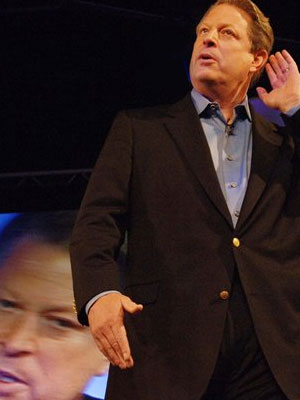
WaPo: Michael Grunwald Suggests Al Gore For 2008 VP


"I'm already involved in a campaign, but it's not a campaign for a candidacy, it's a campaign for a cause. And the cause is to change the minds of people all over the world, especially in the US, about why we have to solve the climate crisis. If we don't do that, the rest of it doesn't matter at all. It won't matter how you are rebembered in the history books if there are no history books. And no one to read them!"

- Former Vice President Al Gore [Speigel Online]


WaPo: Michael Grunwald Suggests Al Gore For 2008 VP

I'll preface this op-ed by saying how much I admire Al Gore and all he has so selflessly done for the American people. Since his excruciatingly painful (and dubious) loss to George W. Bush in 2000, we've seen our nation's international reputation head toward the dustpile. I'd been disappointed and disillusioned when Al Gore had announced that he would not run for President again in 2004, and I often wondered why he would have chosen to let that opportunity slip away and wait another four to eight years to run again in what would surely be a new political world (in light of 9/11 and the immoral Iraq War.) "The gap" gave him time to become more of a trusted authority on Global Warming, an admirable pursuit standing to be of immeasurable value for America and the world. "The gap" also provided George W. Bush with another four years to turn America even further toward the kind of policies that have been a severe detriment to our freedom and progress.

I have been greatly impressed by Mr. Gore's great skills as an orator since he lost that close election to one Supreme Court vote. Pain and adversity can create greatness in us. Yet, his uncertainty and reticence to be a fiery contender in 2004 left the Democrats with an open spot that I personally believe could not have been filled (in a winning sense) by any other candidate at the time. I wish he had not turned away from the timely challenge while it was calling his name so strongly. He blinked.

Eight years later, there are potential 2008 presidential candidates who have the fire (including John Edwards, Hillary Clinton, and Barack Obama). After the bitter division the country has witnessed in Congress for the past five and a half years, these energetic politicians are willing to do whatever is necessary to not only eke out a win in November 2008, but to run away with the majority of votes from Democrats, Independents, and a good majority of Republicans disgusted with the status quo. Mr. Gore is concentrating on environmental issues, and this should be our number one priority, because if we don't have a healthy and sustainable environment, then nothing else matters because nothing can survive (see his own quote at the heading of this post). Mr. Gore has already said that he is uncomfortable with the everyday logistics of the campaigning-life, but he's clearly not uncomfortable with what he's been doing out amidst the people around the nation as he rallies against Global Warming. He has told us that we only have ten years before climate change starts to destroy humanity, and I would rather see an Al Gore who is politically strong, leading, and devoted than an Al Gore who is edged out by a McCain-style Republican in the 2008 general election. If you don't think it could happen, I'd ask you to think again. Remember that, as a Presidential front-runner, Mr. Gore would have to answer to every talking point held to his head like a gun by the Republican party about the pre-9/11 handling of terrorism.

Mr. Gore's own words, as spoken to Spiegel in this interview, were:
I'm a recovering politician. I have run four national campaigns. I have been there and done that. I've found other ways to serve my country and I enjoy them.
Why should we doubt his sincerity? Still, what if Al Gore was willing to take on a high-profile position with which he was familiar and comfortable?


If Michael Grunwald hadn't publicly suggested it first, I probably would have. Al Gore has sage-like wisdom; a politics-shunning humility; he has public respect and admiration; he shows the patriotic desire to serve his country. Judging from the following exchange at Spiegel, I would question whether he'd even consider serving as a VP:
SPIEGEL: Should you have done more about climate change when you were in the White House?

Gore: Well, I enjoyed being in the Clinton-Gore Administration. I'm proud of the work we did. I helped to get the breakthrough at Kyoto and I worked very hard to make changes in US environmental policy. But it wasn't my administration. I shared in it. And I learned in that process that the most urgent need in the US is to change the minds of the American people....
And later in the same interview:
SPIEGEL: And The New Yorker called you "Mr. Ozone," like a superhero. The Economist believes you're a viable rival to Hillary Clinton. Don't you feel at least a little bit flattered that everybody considers you a candidate for 2008?

Gore: Sure. I'm only human. But I'm also old enough now and have been through enough in politics not to take that very seriously. I'm already involved in a campaign, but it's not a campaign for a candidacy, it's a campaign for a cause. And the cause is to change the minds of people all over the world, especially in the US, about why we have to solve the climate crisis.

Would he be willing to spend four to eight more years serving as our Vice President with the opportunity to sharpen the focus on his anti-Global Warming agenda? For me, an Edwards-Gore ticket would be beneficial for America. I think about the effect of this scenario coming true.

Think about Al Gore casting all ego aside and standing behind one other person who could lead extremely well on general issues without the pre-9/11 anvil hanging heavy over his (or her) head, while at the same time standing beside one cause in which he believes so much that he would be willing to make such a humble sacrifice. It would have a powerful influence over the way voters saw both candidates on the Democratic presidential ticket and it would increase political capital as more of the public united in supporting the vision of the two convincing candidates on the ticket. The face of American war would change as we began to focus on poverty at home and throughout the world while leading toward a cleaner and more sustainable global environment with alternative energy moving in to replace our hostage-like dependence on oil.

Dick Cheney was able to focus on the neo-conservatives' goal to get an unnecessary war on in Iraq while he was in the powerful Vice President's seat. Think of an honest person like Al Gore with a productive progressive goal in the same seat and with the same amount of time on his hands as the scheming misleader Cheney, accomplishing a goal that would move us toward oil independence and a return to international cooperation on protecting the environment.

It's just a thought.

I deeply admire and respect former Vice President Al Gore. I cried for him and for this country in December, 2000. Little did I know back then just how much America would come to lose. I believe that his political and personal hesitancy to run in 2004 would be a negative for him in 2008, especially since he was a pre-9/11 leader of the highest profile. Some would say it's never too late, but I disagree. Following Mr. Gore's movements closely over the years, I have come to believe that he has experienced enough adversity, pain, success, and joy in politics that, when he tells us something here in 2006, that he means exactly what he says. We trust him. We need him to serve in whatever capacity he thinks is best for America. We can use his great wisdom and leadership. He isn't just a rhetoric machine with his finger in the air so he can see which way the political wind is blowing. He's made environmental issues his life's work. I consider him to be invaluable to America. My personal hope is that he would not take Mr, Grunwald's idea as any form of an insult, but instead as one of the greatest opportunties for success for all of us.


Friday, July 21, 2006

I am Woman - Celebrate Me


I am Woman - Celebrate Me
By Rachel Raza

From the ashes of Afghanistan
Where you bombed my home and trapped me in a tomb of dust I am the woman who has risen up like the phoenix
Protected by my burqa - which you see as a symbol of oppression
This tattered cloak - is my only protection
from the mortar and shells
that you gift to my land – as you turn it into a living hell
I shatter the bonds, reach out my hand and
gather the wounded and weeping women of my nation,
Stepping over the blood of our children as I teach them to say “no more”
No more - will we be pawns in the games of political power
No more will we cower
We’ll find ways to alleviate our ignorance
I AM WOMAN – EDUCATE ME


I am the woman from a village in Pakistan
where they threw acid in my face because their honour was at stake
Battered, bullied and bruised – I suffered great pain
But the damage they have done has only fired my resolve
to never let them make MY honour, THEIR gain;
I forced the courts to hear my case and took others like me
Caught in the vicious circle of male violence and frenzy
in trying to dehumanize us
My disfigured face has empowered me;
the cries of my sisters have given me strength in my own strength
I won’t be cowed down by cowardly acts
I have found my path and will never return to the fetters of slavery
I ask for no accolades for my bravery
I AM WOMAN – CELEBRATE ME

I am a mother from the Middle East
Step-by-step trying to build bridges of peace
Surrounded by bloody hell
where every shell
has the name of an innocent bystander;
I am Christian, Muslim and Jew
I bleed the same as you
I am wife, sister, friend and daughter
But our lives are devoid of any laughter
When our children leave home,
we are uncertain if they will ever return
I AM WOMAN – VALIDATE ME


I am a woman of the street where I’m forced to sell my body
part by part to the highest bidder – like a commodity
to those masters of the flesh trade who don’t know
that we are women – we have a heart
and a soul that is torn apart
when we are used and abused like pieces of flotsam
set afloat on the sea of time with no end in sight
We’re just a statistic on the pages of her-story
Not for the unequal wages we were paid
Or fighting the laws that are man-made
But - for being the principal victims of AIDS
I AM WOMAN – DON’T HUMILIATE ME

I am the Muslim woman who came to this land
many moons ago
I couldn’t speak the language, I’d never seen snow
I was alone and afraid with no where to go
for help, for advice about my woes
they scoffed at my head-scarf, my faith
my accent and the colour of my skin –
I felt forsaken
Yet I weathered all this on my own
I cried but I survived – thankful to be alive
In this land of the free
But are we ever truly free?
Today I am a victim again –after the terror of 9/11
My windows shattered, my mosque desecrated
It’s ironical - but I am told this turmoil is created
by the very people who wish to liberate me
I AM WOMAN – LIBERATE ME


Most of all I am a woman like the rest of you
Privileged for the chance to share in solidarity
As I build the courage to stand up and speak out
against atrocities heaped upon us
Breaking the bonds of cultural and social fanaticism to forge
a special bond with my sisters
In breaking the silence, I reach out across barriers of
Race and religion – in the one cause that binds us together
Our feminine souls intertwined with the souls of many others
They were women - therefore they died
WE ARE WOMEN – COMMEMORATE US


Wednesday, July 19, 2006

President Carter Podcasts with Senator John Edwards


President Carter Podcasts with Senator John Edwards


Here's something rare - the first of its kind. A former U.S. President has been interviewed by a potential 2008 Presidential candidate. What makes it rare is that the interview has taken place via podcast. President Jimmy Carter gets into the latest technology along with former Senator John Edwards to talk about the decades since he left office, about his vision, and about the personal characteristics that he thinks America needs in an American President.


You can listen to the podcast here. [Duration: 00:27:18 ]


Here is an excerpt from an e-mail from Senator Edwards about the Bookcast:


Our country's history is full of examples of how books sparked political organizing and massive social change. Think about how Harriet Beecher Stowe's Uncle Tom's Cabin provided a compelling -- and widely discussed -- argument against slavery. Or how Rachel Carson's Silent Spring started a national debate about pesticides and gave birth to the environmental movement. That's why book clubs can be so powerful.


In Our Endangered Values, President Carter draws upon his life experience as a president and as a Nobel Peace Prize winner to reflect on what's gone wrong over the past six years. President Carter and I agree that the current administration has made a radical break from the basic values that past presidents, both Democrats and Republicans, embraced as core governing principles -- equality, opportunity and justice. They've been replaced with a rigid fundamentalism, disregard for the truth, contempt for people that disagree, and abandonment of basic human rights.


President Carter is an amazing person, and I was excited to have the opportunity to talk with him. Listen in as we discuss his 20th book.


I hope you will pick up a copy of President Carter's book and join in our blog and discussion for the rest of July. And if you'd like to make a book recommendation for the One America Book Club, we'd love to hear from you.


A Summary of the Podcast Conversation:


After Senator Edwards introduced President Carter, the former President spoke about the personal characteristics that he thinks America needs in a President. The preeminent characteristic he mentioned was integrity; the honesty and ability to tell the truth and to trust the American people, if they have the truth, to support the policies that the President proposes. Next is an element of mental and philosophical flexibility. A President should be capable to accomodate changing times without violating long-standing and unchanging  principles. Other important attributes are: courage, an open mind, the ability to communicate, some degree of charisma and attractiveness, the ability to engender trust in others.


I will put only one part of the conversation in quotes:


President Carter: "I'd like to see a President who tells the truth..."

Senator Edwards: "So would I.."

President Carter:"...and listens to the American people."

Senator Edwards:"..so would I."


President Carter wished to clarify that his latest book, Our Endangered Values - America's Moral Crisis, is not focusing on the problems between "liberals" and "conservatives", nor has he written a referendum on the policies of George W. Bush. In the last five years, however, there has been a radical departure from the path that past Presidents have chosen to take (including Eisenhower, Nixon, and the elder Bush - George HW) when it comes to policy and procedure. In his latest book - his twentieth - he invites all Americans to renew and restore our values, for he believes (and explains how) they are at risk. Others in this world should be able to look at America and say 'there is a mighty nation that believes in peace.... not preemptive war.' America could be reassuring to the world if we tried to address the conflicts that exist between nations by using our tremendous military and economic power in the service of peace.


Our nation has an earned and long-deserved record and reputation of being a champion of human rights, and we need to restore those values. President Carter is aggravated by the fact that our nation helped to orchestrate the Geneva Convention, yet our nation has lately used torture and we have incarcerated others with no access to legal representation or even the hope that their most basic rights will be given to them. Justice, equality of treatment, and fairness are missing from our present course. It is an attack on human rights.


He has seen an overt and persistent committment to distort our nation's tax structures, openly designed to benefit the richest fringes of American society.


The federal minimum wage has been frozen at $5.15 for a decade and has not been indexed for inflation. The current federal minimum wage is half of what most other industrialized nations are paying.


There have been outright attacks on the environment, with attacks on President Nixon's decades-old legislation on air and water purity and a policy of deforestation.


The abuse of the separation of Church and State has been disturbing to President Carter. As a person of Christian faith, he recalled Jesus' command [Matthew 22:21 KJV] to "render unto Caesar the things which are Caesar's; and unto God the things that are God's." The merging of the American political right wing with Christian fundamentalists is a danger of which Thomas Jefferson had written about over 200 years ago.


Senator Edwards mentioned a story told to him by a friend in the Atlanta area about an hour-long sermon heard at a Christian church about the reasons why George W. Bush was thought to be a "perfect example" of what a Christian should be. President Carter has taught Bible school at his Baptist church since he was eighteen years old, and both he and Senator Edwards agreed that you never would have heard anything like that in church twenty years ago, nor would a congregation have deemed it an appropriate Holy sermon. There are extreme and radical ideologies springing up all over the world today - in the Islamic world and in the Christian world alike.


Senator Edwards mentioned that he was working on the issue of poverty and that he was campaigning to raise the minimum wage, assisting with state initiatives across the country. Beyond the minimum wage, he and President Carter agreed that there is much more work to be done to help the poor. When referring to Matthew 25 and what we do "unto the least of these," President Carter said that he had read Reverend Jim Wallis' book "God's Politics" and recalled him saying that there are thousands of Biblical references to the spiritual requirement to help the poor. President Carter believes that we have lost sight of this.


Senator Edwards stated that he'd like to see more Americans and their leaders  engaged in moral issues involving global problems such as stopping the spread of AIDS and preventable diseases and focusing on the humanitarian crisis in Sudan. He believes that this is where American can began to regain some moral high ground and once again show the world a fine example of our national character. President Carter told a story about an enlightening trip he'd taken to Africa with Bill Gates Sr. in conjunction with the Bill and Melinda Gates Foundation. He'd witnessed pregnant women getting the four-dollar treatments they'd needed to preserve the health of their babies yet to be born. He recalled seeing babies who had already been born to mothers with AIDS - but they were AIDS-free because their mothers had had the $4 vaccine. Note: Most African countries spend no more than $10 a year per citizen on all health care. President Carter is haunted by the fact that the American government has been restricting the use of international aid dollars for what they call "family planning." The goal of stopping the spread of AIDS in Africa is defeated because of a dangerous merger between Christian fundamentalism and the American political right wing. President Carter spoke of our government's stingy nature compared to the generosity of Nordic/European nations and private foundations. Senator Edwards said that he could not believe that Americans aren't interested in issues like these because a look at the record of their private generosity and a view of their common values would prove the opposite.


Senator Edwards commented that Americans are sick and tired of the divisive political atmosphere and the lack of civility in Washington D.C. today. President Carter believes that the influence of money in campaigns has been harmful and that legalized bribery must be taken out of the campaign process. Congress has not been able to work in harmony because of the influence of the special interests and their campaign contributions. The system exists to the detriment of the average American and their democratic voice because they have such small, non-competitive amounts of  money to give. The entire process, the Senator and former President agreed, is making the average citizen apathetic toward voting.


When asked a question from a One America Committee blogger named Suswah about President Carter's view of the current state of our nation, he spoke about a particular chapter in his book in which he gave his own description of what a "superpower" should be, and compared it to where we've fallen short in the last twenty years.


One thing that is particularly wrong with the direction we've taken is that, if our government's leaders do not like what another nation is doing, they refuse to talk to any representative of that nation. There is little to be gained by such an approach. President Carter believes that the political right-wing has been influenced by a religious fundamentalist way of thinking: 'We don't deal with those who don't agree with us'; 'We don't talk with inferiors.' It is clear that a war in Iraq was planned long before George W. Bush was ever elected and that it was a coalition of right wing ideologues who have implemented the strategy that has the underlying premise: "A fundamentalist is never wrong." Religious fundamentalism is characterized by rigidity, domination, and exclusion. They are convinced that they are right and anyone who contradicts them is evil. The fundamentalist feels that they have a unique relationship with God - and that they actually speak for God. When there are serious differences between the U.S. and other nations, we cannot brand those who differ as pariahs or inferiors worthy of despise -  yet fundamentalism in foreign policy tends to do just that. It leaves no room for discussing of ideas or for compromise.


Senator Edwards commented that he believes it it is critical for dissenting voices to be heard in America today and to be treated with dignity and respect.


Senator Edwards told President Carter that he thought he was an amazing human being and he thanked him for his participation, encouraging everyone to buy and read President Carter's book.


A special note: Senator Edwards wished President Carter and his wife, former First Lady Rosalynn Carter a very happy 60th wedding anniversary. The couple celebrated their special day on July 7th.


See mbair's Diary at Daily Kos.


*Cross posted at the One America Committee blog


Tuesday, July 18, 2006

Personal Revolution Creates Path to Progress


Personal Revolution Creates
Path to Progress


I thought you might appreciate this little bit of wisdom and advice to speed you on your daily way. It takes a day-to-day personal revolution to make any kind of social progress.

If someone says that they think they know everything, it's a sure sign that they probably know nothing.

From a recent interview with a Jesuit astronomer (LeMoyne College magazine):


Do you think there is hope that we can reconcile this perceived divide between science and religion?

There is hope; there’s always hope. And some of it comes from education. Although education is not the solution to everything, everything depends on education. Some of it will just come from people growing up and being more used to the idea. There has been a generational divide. I think scientists of the generation ahead of me were much more reluctant to talk about their religious beliefs in public. That’s not true anymore, certainly not in astronomy and physics. And there’s no longer the sense that if you’re a religious person you’re somehow less of a scientist. You still see that in the older scientists… but you don’t see it in the young people coming up anymore. And that culture has changed in the sciences. I don’t see any reason why that culture couldn’t change in religion as well.

Will there always be new scientific discoveries?

I hope so. My father had a wonderful thing he taught me as a kid: Knowledge is like a circle. The more you know, the bigger the circle. But the circumference of the circle is the things that you know you don’t know. And the bigger the circle gets, the bigger the circumference gets. So the more you know, the more you realize there’s still to be learned. And if you think you know everything, it means you know nothing.


Keeping Our Minds Supple
Questioning Everything


A lot of people feel threatened if they feel they are being asked to question their cherished beliefs or their perception of reality. Yet questioning is what keeps our minds supple and strong. Simply settling on one way of seeing things and refusing to be open to other possibilities makes the mind rigid and generally creates a restrictive and uncomfortable atmosphere. We all know someone who refuses to budge on one or more issues, and we may have our own sacred cows that could use a little prodding. Being open-minded means that we are willing to question everything, including those things we take for granted.

A willingness to question everything, even things we are sure we are right about, can shake us out of complacency and reinvigorate our minds, opening us up to understanding people and perspectives that were alien to us before. This alone is good reason to remain inquisitive, no matter how much experience we have or how old we get. In the Zen tradition, this willingness to question is known as beginner's mind, and it has a way of generating possibilities we couldn't have seen from the point of view of knowing something with certainty. The willingness to question everything doesn't necessarily mean we don't believe in anything at all, and it doesn't mean we have to question every single thing in the world every minute of the day. It just means that we are humble enough to acknowledge how little we actually know about the mysterious universe we call home.

Nearly every revolutionary change in the history of human progress came about because someone questioned some time-honored belief or tradition and in doing so revealed a new truth, a new way of doing things, or a new standard for ethical and moral behavior. Just so, a commitment to staying open and inquisitive in our own individual lives can lead us to new personal revolutions and truths, truths that we will hopefully, for the sake of our growth, remain open to questioning.

- From the Daily Om


Monday, July 17, 2006

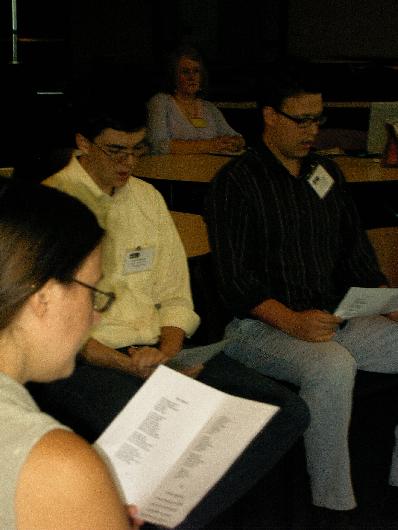
Photos from the Progressive Faith Blog Conference


Photos from the Progressive Faith Blog Conference


Saturday, July 15, 2006
Montclair State University, New Jersey
Google Blog search
Faithful Progressive asks: What is progressive faith?
Velveteen Rabbit on Roundtable: What is Progressive Religion?
Chris Walton - Religion magazines worth knowing about


From top to bottom:
An early morning meditation session
Thurman Hart leading a beakout session (see his conference-opening remarks)
Mainstreet Baptist (Dr. Bruce Prescott in red shirt) speaks during a group discussion
Lorianne (Hoarded Ordinaries) leads a Zen meditation
Islamoyankee (of Islamicate) and Rabbi Jill (of JSpot)
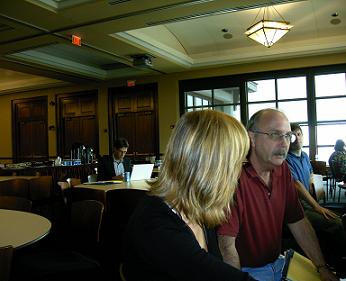
Laptops await their owners in the conference hall.
Nathan Newman (of TPM Cafe) speaks during a group discussion

U.S. Lacking in Moral Leadership on Middle East


U.S. Lacking in Moral Leadership on Middle East

"We've lost the high moral high ground everywhere in the world. We want to be respected around the world again. We want our moral authority to be restored, because part of defending America is not just well-armed troops; it's having the high moral ground."

- Howard Dean, Chairman, DNC


There will be a negative economic impact - potentially extreme - from the recent Middle East instability created by Israel's own decision to act agressively after the capturing of several Israeli soldiers. Investors are spooked with good reason. The Lebanese economy, already vulnerable, will also be negatively impacted. Oil prices hit $78 per barrel on July 14th, and we can only expect more market instability as the fates and fortunes of places like Iran, Israel, and Nigeria are swept with the raging fires of war in the region.

What has our own American leadership done to create such an unstable environment? What has our American leadership done to relieve such tensions? These are the questions we need to be asking, for our national security is not only tied to minimizing the chances of terror attacks. The price each consumer must pay at the pump and for heating their homes in the dead of winter has everything to do with our national security. At such a time of uncertainty, I think about the Bush administration's burning desire to out a covert CIA agent who was working on oil-related national security matters and I think about a journalist named Bob Novak who seems to have been all too willing to carelessly help the Bush team to accomplish their terrible mission aimed toward personal destruction. The real result, despite errant excuses from the right wing, was a breakdown in our CIA's ability to safeguard our national security.

I think about the way, pre-9/11, that former Middle East envoy Tony Zinni's hands were tied by the Bush administration. I think of the times when General Zinni rightly criticized the misguided neo-conservatives in the Bush administration who saw the invasion of Iraq as some magical path to stabilization of U.S. interests in the region (including Israel), and he was viciously and wrongly called an "anti-Semite." We wasted precious time remaining diplomatically inactive in the region while making a totally unnecessary war upon Iraq. Chickenhawk neo-conservative maniacs like Bill Kristol, in his inimitable opportunistic way, dig their talons into the current instability in the Middle East and attempt to use it to further their deadly Utopian cause, of which misery, chaos, death, and failure have become a hallmark. Make no mistake, Bill Kristol wants to send your sons and daughters to his wet-dream of WWIII and the pliant President of the United States has a terrible track record when it comes to falling in with the foreign policy goals of the neo-conservatives.

More death - more economic hardship - more people around the globe ignored as they die from preventable diseases - no effective diplomacy - more hunger - virtually no progress in developing alternative energy resources - fewer opportunities here at home - more greed - God's environment ignored on behalf of the rich polluters at the expense of humanity - more partisan division in Congress as the conservative right is merely pandered to by those who claim to represent them - and not a snowball's chance in Hell for peace on Earth.

This is surely not what civil and/or faithful Americans bargained for when they trusted President Bush enough to give him four more years to sucessfully prosecute his war on terror.

We hear that Secretary of State Condoleeza Rice will pay a visit to the Middle East, but no one can say when. President Bush hands over responsibility for peace to the UN, something he clearly did not entrust them with when he unilaterally and impulsively walked over them and rushed to war with Iraq in 2002/2003. Today Bush said, "What [the United Nations] need to do is to get Syria to stop Hezbollah from doing this shit." So where's Bush's magic man John Bolton? While the majority of the United Nations supports the Lebanese government, saying, "We support the call for a cease-fire and their aim of exercising full authority over the entire country" Bolton one-sidedly blusters, saying the following when reporters asked him why the United States didn't appear interested in pursuing calls for a cease-fire at this time:
"I think that the question of the legitimate exercise of self-defense, which the government of Israel is seen engaged in, is something that has to be considered very clearly..I think before you get to cease-fire you have to look at what the causes of the conflict are..I think you would have a cease-fire in a matter of nanoseconds if Hezbollah and Hamas would release the kidnapped victims and stop engaging in rocket attacks and other acts of terrorism against Israel."
How will the UN's goals to get the parties to agree to an "immediate cessation of hostilities in order to to give diplomacy time and space to work" ever be realized when John Bolton acts as if there is only one party with whom to be contended?

Today on Amy Goodman's show Democracy Now, Chris Hedges, a seasoned war correspondent and author of books on the issues of war and faith said:
Washington is probably the one force that can step in -- and not always successfully, as we’ve seen in the past -- and bring some kind of restraint to Olmert's hand, but Washington's refusal to do that thrusts us in an incredibly dangerous environment, where there is no one to stay the hand of the Israeli government. There are no checks, there are no restraints. We don't know how far they’re going to go.

What will President Bush and his administration do about the Middle East now that we're watching closely and now that we know of their many misguided (and misleading) failures? Will he fall in with Bill Kristol's proclamation that the Arab-Israeli conflict is "our war" and will Bush cave in to Kristol's cojones-threatening accusation that Bush has done 'a poor job of standing up to [Iran and Syria] and weakening them'? With the damaged public trust attached to the New York Times and the Washington Post beacause of their pre-Iraq war "steno-padding" of Bush administration propaganda, I don't imagine that Bush will get any more free passes from the mainstream press. His perceived lack of honesty, transparency, intelligence, intuition, and competence will not win him any free passes from the American public.

Americans of faith cannot tolerate - and we must not allow our representatives to fall into a scenario where we'll "Iraq" Iran. The goal leading to the killing of thousands of Iraqi civilians and the destruction of Iraq's infrastructure is so far out of proportion to any good it could have done for the advancement of human rights and/or the reduction of terror that the very thought of expanding that same war into other nations, effectively extending the dreadful lie that brought us to Iraq's unfortunate doorstep, is morally repulsive.

To everything there is a season. Rabbi Michael Lerner recently called this a defining moment for the relationship between Israel and Americans of faith. This is a time for intuitive diplomacy and wise peacemaking in defense of the rule of law, civility, and human rights; it is not a time for responding to maniacal calls for more war.

~~~~~~~~~~~~~~~~~


- See End the Suffering in the Middle East By Rabbi Michael Lerner, Tikkun, Sunday 16 July 2006


- See Stephen Rockwell's Cross Left blog for a Rapid Response opportunity:
Tell Bush to Lead Israel, Gaza, and Lebanon in the way of peace


____________

"I pray that Peace will come to the Middle East and to the World. But it first has to exist in your hearts, our hearts. All our hearts. Fear not. Rather love...with all your might, and all your heart. Pray for your enemy as well."

- The blogger known as Anonymoses

____________


Political Humor in Kayak.com Ads


Political Humor in Kayak.com Ads

In case you haven't seen them, there are some amusing political ads that have been created and uploaded at YouTube.com by the popular travel website Kayak.com. Here are two samples:


I find it interesting, not just in this case, but in the overall business environment - thinking about the many ways a start-up could use the free uploading service at YouTube.com to employ creative advertising to compete with more established markets.


Wednesday, July 12, 2006

President Jimmy Carter and Sen. John Edwards Podcast in Atlanta


President Jimmy Carter and Sen. John Edwards Podcast in Atlanta


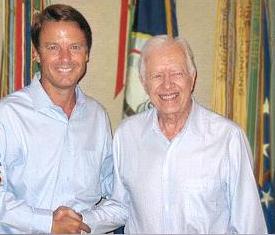
The photo you see on the left features Senator John Edwards and former President Jimmy Carter. Would you believe that they were podcasting at the Carter Center in Atlanta today? The podcast (also known as a 'Bookcast') is due to be up at the One America Committee (OAC) media center early next week. The special Bookcast will include questions from readers of the One America Committee Book Club where we've been discussing President Carter's book Our Endangered Values: America's Moral Crisis [Simon and Schuster]. I have been moderating the Book Club and I can't begin to tell you how thrilled I am that President Carter so kindly agreed to participate in this podcast with Senator Edwards.

A sidenote, President Carter and his gracious wife Rosalynn were fresh off of a trip to Nicaragua where there were preparations being made for monitoring November's elections, and they came back home to quietly celebrate their 60th wedding anniversary last Friday in Plains. What a couple - and what exemplary lives they've led - separately and together.

Reagan-Era Ally Gorbachev: Rumsfeld and Cheney Are Shallow Hawks


Reagan-Era Ally Gorbachev: Rumsfeld and Cheney Are Shallow Hawks

Former Russian leader Mikhail Gorbachev mentions that Bush has "character", and you will note he did not mention what kind of character...he only says it involves being determined. The fact that he classifies Rumsfeld and Cheney as shallow hawks and Americans as people with a winner's complex leads you to see that he sees Bush as a stubborn bully with a superiority problem who falls in with shallow hawks.

Rep. Hoekstra Late in Questioning Bush on Intelligence


Rep. Hoekstra Late in Questioning Bush on Intelligence

The Whistleblowers' (NSWBC) Dirty Dozen List includes Rep Peter Hoekstra, who is finally shedding some of his partisan Fox News defensiveness toward our power-abusing president.

Rep. Hoekstra, like so many of his fellow rubber stamp colleagues in Congress, is a day late and a dollar short. Democrats have been screaming for meaningful investigations and have been called unpatriotic by these obfuscating partisans who lead the committees repsonsible for oversight. Shame on them. They only come out of their rubber stamp shells when an election looms in their future.

A Popular Yet Irresponsible Right Wing Blog


A Popular Yet Irresponsible Right Wing Blog

A very popular right wing blogger is being highly irresponsible. See Glen Greenwald.

Senator Obama Interviewed by Pastor Dan


Senator Obama Interviewed by Pastor Dan

See Pastor Dan's interview with Illinois' Junior Senator Barack Obama here.

Hot Soup Coming in October


Hot Soup Coming in October

Have you heard about Hot Soup? Howard Kurtz describes it as a Web site that a group of political strategists hopes will eventually reach 30 million opinion leaders, elevate public discussion on matters from politics to sports to culture and, in the process, make them some money.
Sounds pretty savvy - pretty slick. Just like my blog. (Hahahaha.) I'm sure it will be interesting. Sister Wonkette says..

Et Tu, Bob Woodward?


Et Tu, Bob Woodward?
We know by now that Judy Miller, the New York Times, and the Washington Post were conned and used in the days leading up to the disastrous Iraq War - but who would have believed that Woodward would slide down to a steno pad career at the President's service?

Robert Parry reports his suspicion that Bob Woodward was not playing the part of an investigative jounalist in 2002:
[..] "...in the two years since publication of Plan of Attack, other evidence has emerged suggesting that Woodward was acting less as an objective journalist than as a stenographer taking down the preferred history of Bush’s inner circle. The legendary hero of the Watergate scandal may have been the one who was slam-dunked."


See the article here.
[...] According to [Ron] Suskind, the two CIA officials—Tenet and McLaughlin—have very different recollections of the Dec. 21, 2002, meeting. They remember it more as “a marketing meeting” about how to present the WMD case, not a review of the quality of the underlying intelligence.

Both Tenet and McLaughlin say they don’t even recall Tenet exclaiming the words “slam dunk,” although Tenet won’t dispute the version from Bush and his top aides, Suskind wrote.

“McLaughlin said he never remembered Tenet saying ‘slam dunk,’” Suskind wrote. “He doesn’t recall Tenet ever, in any context, jumping up and waving his arms.... The President’s question, McLaughlin recalled, was ‘whether we could craft a better pitch than this—a PR meeting—it certainly wasn’t about the nature of the evidence.’”

Mr. Parry reports that the preponderance of evidence tilts against Mr. Woodward’s version of the "slam-dunk" story.
For instance, in 2005, leaked British documents revealed Bush—in 2002 and early 2003—to be eagerly pushing U.S. intelligence agencies toward hyping and twisting the evidence to build the strongest possible case against Saddam Hussein’s regime.

According to one of those documents, the infamous Downing Street Memo, dated July 23, 2002, British Prime Minister Tony Blair had already secretly agreed to Bush’s plan for invading Iraq—nearly a half year before the “slam-dunk” meeting.


A Father Speaks About Mental Illness and Suicide


A Father Speaks About
Mental Illness and Suicide


As a rule, I do not post entire articles because of ethics and copyright issues. I feel so strongly about the issue of mental health, suicide, and depression that I would prefer that this heartfelt column by Richard Moe be reposted in its entirety so that no meaning is lost in abbreviation.


What my son couldn't tell us
Column by Richard Moe

The recent death of publisher Philip Merrill brings to mind the observation of Henry David Thoreau that the mass of men lead lives of quiet desperation. While it's impossible to know exactly what motivated Merrill to take his own life, few, if any, apparently saw signs that caused them to suspect he might be considering doing so. And so it is with those who contemplate this final act; it is the most personal decision an individual can make, not to be shared with family or friends but to be reached entirely alone.

Our son Eric took his own life three years ago. He was an extraordinarily gifted young man of 35 - an artist and self-taught architect and designer with remarkable intuitive abilities. He also possessed a wonderful sense of humor, enormous personal integrity and an exuberance for life that made it inconceivable he would ever choose to end it.

But in recent years he had suffered an increasingly debilitating series of episodes that temporarily immobilized him. He worked hard to understand and overcome his problem, and he sought help.

Two months before his death he was diagnosed as having bipolar disorder. Although he began taking a prescribed medication, he continued to experience great pain, and he told me twice that he didn't know what was happening to him. We could find no safe place for him to go. He was very close to his family, and we know he didn't want to hurt us. But in the end he concluded, for reasons that will never be fully known to us, that he had no other choice.

Our society does not encourage conversation about death, and certainly not about suicide. The silence can sometimes be deafening for families that have experienced it.

The taking of one's own life is still a taboo subject in most places, laden as it is with judgment. Many people still associate suicide with shame, as if it were a morally heinous albeit tragic event.

It has been our family's experience that most people are reluctant to raise the subject because, in addition to being uncomfortable with it, they do not want to cause us more pain. On the contrary, we feel no shame regarding Eric's death, and we are eager to talk about him because we loved and respected him to the end and still do. We wish he hadn't taken his life, but his life still has great meaning for us. I am especially proud of how courageous he was to live as long as he did with this debilitating illness and how he developed his spirit to help him endure pain that cannot be imagined.

Most suicides are related to some form of mental illness - depression, acute anxiety or myriad other disorders. We cannot begin to understand these disorders and their consequences until we acknowledge and discuss them frankly and publicly.

Millions of Americans suffer from some form of depression; I am one of them. Compounded as it is by the increasingly stressful nature of our society, particularly in such intense work and social environments as Washington and New York, it is probably no exaggeration to say that America is on its way to a mental health epidemic.

Fortunately, a few people are helping us to see mental illness for what it is - a complicated illness that needs to be acknowledged and dealt with like any other.

Former first lady Rosalynn Carter has been making this point forcefully for decades. Kay Redfield Jamison, a professor of psychiatry at Johns Hopkins University, wrote eloquently of her own attempted suicide in her classic, "An Unquiet Mind." In publicly acknowledging the need to take medication for the rest of her life, she has become a leading advocate for greater awareness and for how medication can save lives. Sen. Gordon Smith, an Oregon Republican, has recently written a deeply moving book, "Remembering Garrett," about his 21-year-old son's suicide.

These are important contributions to public understanding that are necessary if we are to lift depression and the suicide it sometimes causes out of the shadows and into the daylight. Only then can the mass of men and women who lead lives of quiet desperation hope to lead lives of peace and fulfillment.

Richard Moe is president of the National Trust for Historic Preservation. This column originally appeared in the Washington Post.